
7 min read · Last updated August 17, 2026
- A repair shop’s “shop supplies” fee often runs 7 to 8 percent of the repair cost, calculated as a straight percentage rather than the actual cost of what your specific repair used.
- California’s Bureau of Automotive Repair bans this outright. Section 3356(g) prohibits billing a generic “shop supplies” line at all, and anything you are charged for has to appear as a specific item on the invoice.
- Illinois takes a different route, capping how far any repair invoice can exceed its written estimate at 10% without your authorization.
- Car Talk’s own reporting found drivers paying 7 to 8 percent of their bill for supplies even on jobs, like a window regulator repair, that use none at all.
In this article
- The $132 Line That Wasn’t Parts or Labor
- The Percentage Formula Behind It
- Why “Hazardous Waste” Doesn’t Always Mean What It Sounds Like
- How States Actually Regulate These Fees
- What to Ask Before You Pay It
- FAQ
Priya’s brake job invoice showed $780 in labor, $290 in parts, and a $132 line labeled “shop supplies and hazmat disposal.” That third line was 11% of her $1,202 total. Nothing on the invoice explained what it actually paid for.
The $132 Line That Wasn’t Parts or Labor
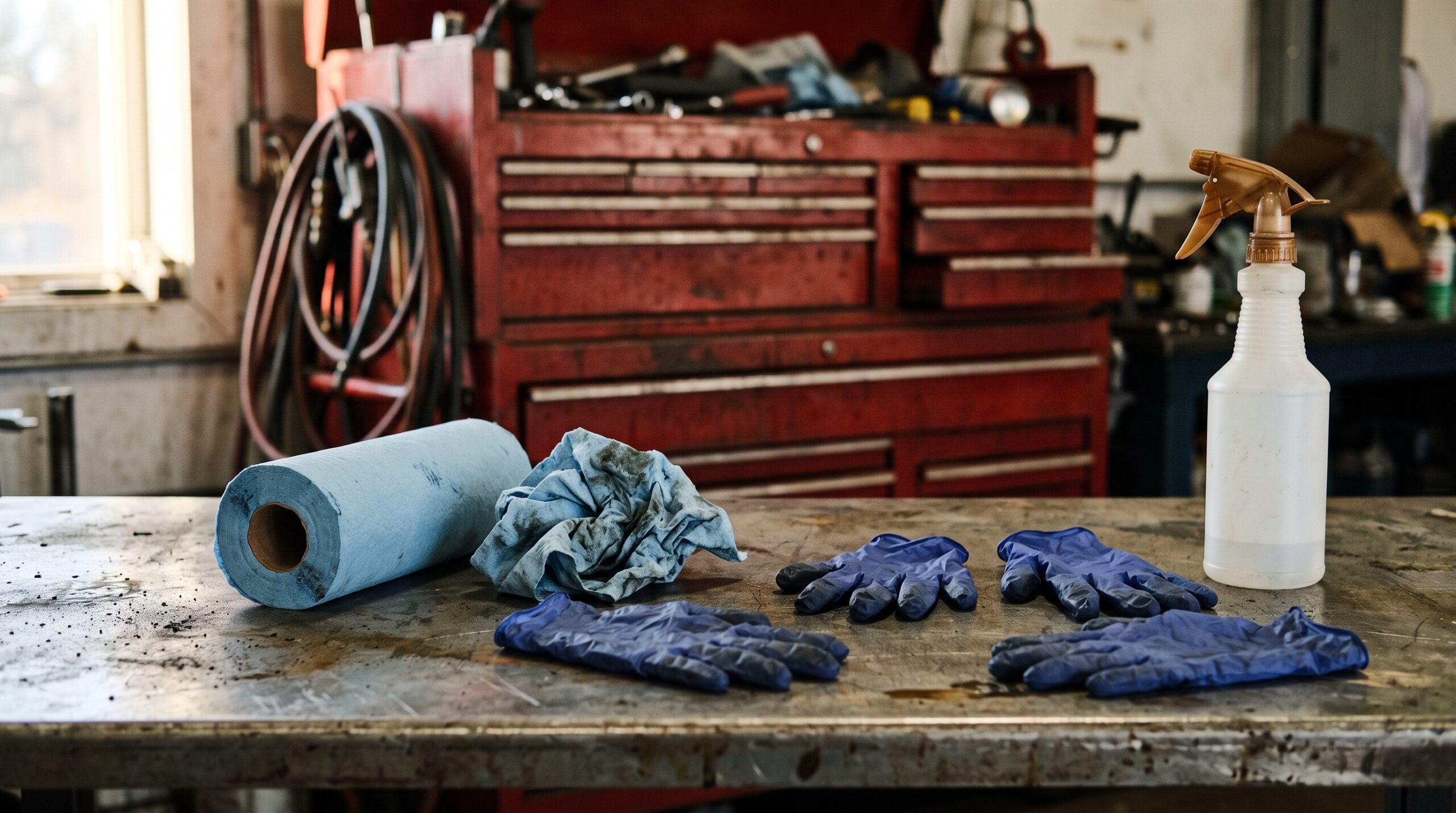
Shop supplies and hazardous waste fees cover the consumables a repair actually burns through. That’s brake cleaner, shop rags, disposable gloves, the fluid absorbent used to catch a spill, and the cost of hauling away used oil, coolant, and brake fluid. Those are real costs. The question is whether the number on your invoice reflects them, or just reflects a formula applied to every repair order regardless of what it used. When the repair in question traces back to a failed state inspection rather than routine service, what each failed-inspection item costs to fix breaks the bill down by the specific failure point instead of a flat shop-supplies formula.
Car Talk’s Tom and Ray Magliozzi answered a reader’s version of this exact question in a 2008 column. Some shops, they wrote, “charge a percentage of the repair cost” for shop supplies. Their example was a window regulator job, which needs no rags, cleaners, or solvents at all. They said it could still carry 7% or 8% of the bill in supply charges.
The Percentage Formula Behind It
Priya’s $132 fee is 11% of her $1,202 bill, above the 7% to 8% Car Talk describes. Measured against her $780 of labor alone it is nearly 17%, but the benchmark is a share of the whole repair, so 11% is the number to compare. The mechanism is straightforward once you see it. Instead of tallying the actual rags, cleaner, and disposal cost for your specific repair, many shop-management systems apply a flat percentage to the labor line and call the result “shop supplies.” That same percentage gets applied whether the job used a full case of solvent or nothing at all, which is exactly the window regulator example Car Talk flagged.
| What’s on the invoice | What it actually reflects |
|---|---|
| “Shop supplies,” calculated as % of labor | A formula applied to every repair order, regardless of what your car’s repair used |
| “Hazmat disposal fee,” flat amount | Sometimes a real disposal cost, sometimes a flat charge on a substance with an established recycling stream |
| Itemized supplies (California only) | The supplies actually used on your vehicle, itemized on the invoice, by law |
| Best for | Deciding whether to ask the shop to itemize before you pay |
Why “Hazardous Waste” Doesn’t Always Mean What It Sounds Like
The word “hazardous” on an invoice line implies the shop is paying to get rid of something dangerous and unwanted. For the most common automotive waste, that’s not quite the full picture. The Environmental Protection Agency (EPA)’s own guidance for businesses sets out the good housekeeping requirements for used oil handlers under Title 40 of the Code of Federal Regulations (CFR) Part 279. The same page notes that used motor oil can be re-refined and sold as motor oil again, or processed into furnace fuel oil. That doesn’t mean every hazmat line is inflated. Brake fluid, coolant, and certain solvents genuinely do cost money to dispose of correctly. It does mean “hazardous waste fee” is doing a lot of rhetorical work for a substance with an established recycling stream behind it.
How States Actually Regulate These Fees
States don’t agree on how to handle this, and the differences are sharp. California’s Bureau of Automotive Repair prohibits the fee outright in its generic form: shops there cannot bill a blanket “shop supplies” or “miscellaneous” charge at all. California Code of Regulations Section 3356(g) is one sentence: separate billing for items “generically noted as shop supplies, miscellaneous parts” and the like is prohibited. Sections 3356(c) and (f) close the loop, requiring each service and part to be itemized with its price, and barring a separate charge for anything not listed on the invoice. BAR’s own guidance adds that the supplies billed must be the ones used on your vehicle.
Illinois regulates a related but different piece of the puzzle: consumer estimates. The Illinois Attorney General’s office confirms that under the state’s Automotive Repair Act, an itemized written estimate can’t be exceeded by more than 10% without your authorization. That puts a ceiling on the invoice’s total, even though it doesn’t specifically police the shop-supplies line inside it.
What to Ask Before You Pay It
You don’t need to know your state’s specific rule to ask the one question that matters: “Can you itemize what the shop supplies fee actually covered on my repair?” A shop with a legitimate, usage-based fee can answer that. A shop applying a flat percentage regardless of the job usually can’t, because there’s nothing behind the number to itemize.
If the fee looks high relative to your labor total, compare it against the rest of your repair estimate the same way you’d question any other line. Ask whether it changes if the job doesn’t actually require rags, solvent, or fluid disposal. A dealer and an independent shop can both apply this fee, so don’t assume one type of shop is automatically the honest one. The invoice itself is the only evidence that matters.
Frequently asked questions
Is a shop supplies fee always a scam? No. Shops genuinely spend money on rags, cleaners, gloves, and fluid disposal, and it’s reasonable to bill for that. The concern is a flat percentage applied to every repair order regardless of what it used, which is a formula, not a reflection of your specific repair’s actual cost.
What’s a reasonable amount to pay for this fee? There’s no single national rule, since states regulate it differently. The clearest test isn’t a percentage, it’s whether the shop can explain what the fee covered on your specific repair. If they can’t itemize it, that’s the bigger flag than the exact number.
Can I refuse to pay a shop supplies fee? You can ask that it be removed or itemized before you authorize the repair, not after the work is done. Once you’ve signed an estimate that discloses the fee, you’ve generally agreed to it, so raise the question up front.
Is my state’s rule the same as California’s? Almost certainly not. California specifically bans blanket shop-supply and miscellaneous charges. Most other states allow the fee as long as it’s disclosed, and some, like Illinois, police the invoice total instead through a cap on how far it can exceed the written estimate.
Does a hazardous waste fee mean the shop is losing money on disposal? Not necessarily. Used motor oil has an established recycling stream behind it, and the EPA notes it can be re-refined and sold as motor oil again or processed into furnace fuel oil. Other fluids and solvents do carry real disposal costs, so the fee isn’t automatically fake, but it isn’t automatically a straight pass-through of a real expense either.
Leave a Reply