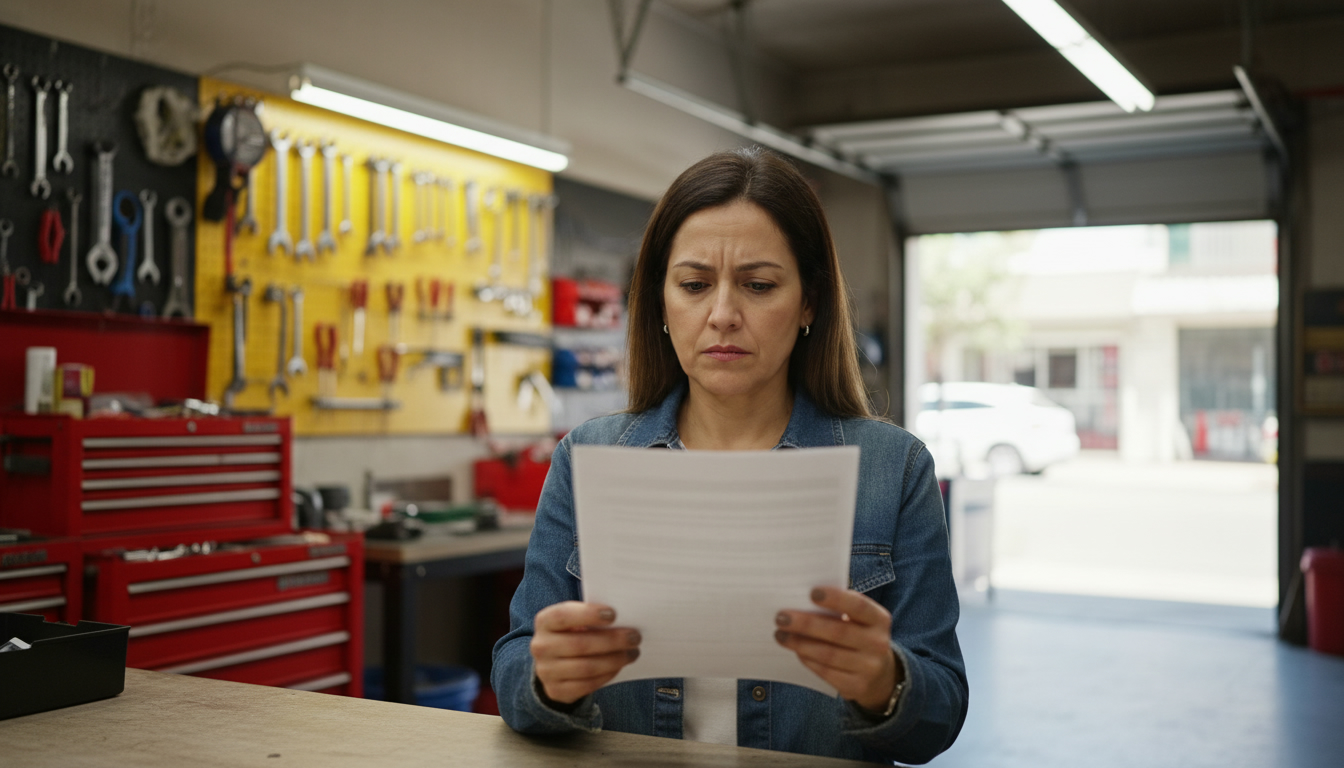
Your Repair Estimate Says $1,190. Here Is How to Read It Before You Approve It
5 min read · Last updated July 28, 2026
By the YourAutoOptions Editorial Team. Reviewed by Steven Sun.
- Labor was 47 percent of a $1,190.62 estimate. The part that failed was 23 percent.
- The median automotive technician earns $24.34 an hour. Your invoice rate is several times that, and the gap is overhead, which is why arguing the rate never works.
- Most shops bill flat rate: a published book time, not the hours the technician spent.
- Your written estimate must name the condition, the parts and the labor charge, and many states require your old parts back.
In this article
- The labor line is most of the bill
- Book hours are a published number
- A real estimate, line by line
- What a written estimate has to contain
- Frequently asked questions
The service advisor slid a printout across the counter: $1,190.62 to fix a coolant leak on a 2019 Honda CR-V. The water pump that failed was $268 of it. The other $922 came from six lines nobody thinks to question.
The labor line is most of the bill
On that estimate, labor was $561, or 47 percent of the total. Normal, when the part is cheap and the access is bad.
Here is the number almost nobody knows. Bureau of Labor Statistics occupational wage data for 2025 counts 704,640 automotive service technicians and mechanics. Median pay is $24.34 an hour, the bottom ten percent at $16.66 and the top ten at $39.32. The rate posted on your invoice is several times that.
That gap is not the technician getting rich. It covers the building, the lift, scan tools that cost five figures, parts inventory, insurance and the front desk. Asking a shop to cut its posted rate asks it to lose money on your car. Asking whether the job really takes 3.4 hours is a fair question with a checkable answer.
The direction of travel is against you. The BLS motor vehicle maintenance and repair index, series CUUR0000SETD, rose 7.0 percent in the year to June 2026 alone.
Book hours are a published number
The Federal Trade Commission’s Auto Repair Basics guidance names two billing methods. Some shops charge a flat rate, which the FTC describes as a published rate “based on an independent or manufacturer’s estimate of the time required to complete repairs.” Others bill actual time.
Flat rate is the norm. A guide says a CR-V water pump is 3.4 hours, so you pay 3.4 hours whether the technician finishes in two or fights it for five. Two questions follow. A third is worth asking if the shop wants to add a second repair to the same visit: does the second job actually share teardown labor with this one, or is it riding along on a separate invoice line. Our guide to bundled repair savings shows how to tell the difference.
- Which labor guide, and how many hours does it show? Guides differ. A shop quoting well above book time should say why, usually rust or a seized bolt.
- Are any of these jobs overlapping? If the thermostat sits behind the same cover as the pump, you should not pay full book time twice to open it.
A real estimate, line by line
| Line on the estimate | Amount | What to ask |
|---|---|---|
| Diagnostic | $175.00 | Credited back if I approve the repair here? |
| Labor, 3.4 hours at $165 | $561.00 | Which labor guide, and how many hours? |
| Water pump, new original equipment | $268.00 | Cost and warranty on a remanufactured unit? |
| Thermostat and gasket | $54.00 | Required now, or bundled? |
| Coolant, 2 gallons | $58.00 | The type my manufacturer specifies? |
| Shop supplies, 8 percent of labor | $44.88 | Capped, and covering what? |
| Sales tax, 7 percent on parts and materials | $29.74 | Is labor taxable in my state? |
| Total | $1,190.62 |
Two substitutions move real money on this ticket.
That $175 diagnostic line is worth a follow-up question on its own, especially if the fault that brought you in doesn’t show up every time. When a problem is intermittent and never sets a stored code, ask upfront whether a second diagnostic charge applies if the shop can’t reproduce it that day.
A shop at $135 an hour. The same 3.4 book hours becomes $459 and the supply fee drops to $36.72. After tax the total lands near $1,079.89, about $111 less.
A remanufactured pump instead of new original equipment manufacturer (OEM) stock. The FTC classifies parts as new, remanufactured or salvage, and notes remanufactured parts have been “restored to a sound working condition.” A reman pump at $164 instead of $268 takes about $111 off with tax.
Both together put identical work near $970. That is why you get a second written estimate over about $800, the comparison our dealer versus independent shop breakdown runs in full.
What a written estimate has to contain
The FTC is specific. A written estimate “should identify the condition to be repaired, the parts needed, and the anticipated labor charge.” You get a signed copy. It should also “state that the shop will contact you for approval before they do any work exceeding a specified amount of time or money.” State law often requires that clause.
When the work is done, ask for a repair order listing each repair, the parts supplied, the cost of each, labor charges, and the odometer at drop off and completion. Ask for your replaced parts back. Many states require the shop to return them, and a pump that comes back dry and intact is a conversation worth having.
Two more habits. Ask whether the diagnostic fee applies if you take the car elsewhere, and get a second opinion on anything expensive before authorizing, as the FTC recommends. If the quote has you weighing whether to keep the car, our trade in versus private sale breakdown prices the alternative.
The labor-hours line on that estimate usually is not a record of anyone’s actual clock time. Here is where those hours actually come from, and what it means for your bill.
Reading the estimate is step one. Knowing what happens if the real total grows past it mid-job is step two, covered in what your state actually requires before a shop can bill you more than the estimate.
Frequently asked questions
Can I negotiate a repair estimate?
Not the hourly rate. Negotiable: the scope, the parts grade, and whether the diagnostic fee is credited back. Asking for a remanufactured part instead of new OEM stock moves more money than haggling over the rate. That single line item is worth understanding on its own, since the savings and the warranty coverage differ sharply between a used, remanufactured, and new part.
Is a shop allowed to charge more than the estimate?
Generally not without calling first. The FTC says your estimate should state that the shop will contact you before exceeding a set amount of time or money, and many states require it.
What is a shop supplies fee actually for?
Consumables not worth itemizing: rags, cleaners, lubricants, fasteners, fluid disposal. Usually a percentage of labor, often capped. An uncapped 10 percent deserves a question.
Should I bring my own parts?
Most shops refuse, and those that agree will not warranty the part or the labor. If it fails you pay the full labor again, which outweighs the parts markup.
Leave a Reply