7 min read · Last updated October 28, 2026
- A front-axle brake pad job saves about $210 doing it yourself: $55 in parts against a $265 shop total at $120 an hour.
- Seven of the ten jobs save real money with no meaningful downside, led by brake pads at $210 saved and the serpentine belt at $78 saved.
- Spark plugs, batteries, and headlight bulbs can flip from a discount to a loss of $38 to $270 if one realistic mistake happens.
- Shops nationwide price labor between $120 and $159 an hour, per the American Automobile Association, so this article uses $120 as its baseline rate.
Do-it-yourself (DIY) work on ten common car maintenance jobs saves between $30 and $210 per job compared to a $120-an-hour shop. Three of those ten jobs can cost more than the shop price once you price in one realistic mistake.
In this article
- Where DIY car repair costs beat the shop
- The brake pad math: a full worked example
- The three jobs where DIY costs more
- What tools you actually need before you start
- Frequently asked questions
A front brake pad job that runs $265 at a shop costs about $55 in parts when you do it yourself, a $210 difference in DIY car repair costs. That gap holds for most of the ten most common maintenance jobs, but three of them can flip into a loss once a realistic mistake enters the picture.
Where DIY car repair costs beat the shop
The American Automobile Association reports that almost half of U.S. auto repair shops price their labor between $120 and $159 an hour. This article uses $120, the low end of that real range, as a conservative, repeatable baseline for every job below.
The table below compares typical do-it-yourself parts costs to typical shop totals, parts plus labor, at that $120 rate. Shops mark up parts on top of labor, which is why the gap is often bigger than the labor charge alone.
| Job | DIY Parts Cost | Shop Total | DIY Savings |
|---|---|---|---|
| Oil change (synthetic) | $42 | $90 | $48 |
| Engine air filter | $12 | $45 | $33 |
| Cabin air filter | $16 | $65 | $49 |
| Wiper blades (pair) | $18 | $48 | $30 |
| Battery | $145 | $225 | $80 |
| Brake pads (front axle) | $55 | $265 | $210 |
| Spark plugs (4-cylinder) | $36 | $178 | $142 |
| Serpentine belt | $30 | $108 | $78 |
| Headlight bulb | $14 | $58 | $44 |
| Coolant top-off | $14 | $45 | $31 |
| Best for | DIY: oil changes, filters, wipers, brake pads, the serpentine belt, and coolant top-offs, for anyone with a basic socket set and an hour to spare. Shop: spark plugs, batteries, and headlight bulbs, where one common mistake can erase the savings and then some. | ||
An engine air filter swap is one of the clearest wins on this list. Parts run $10 to $15, while an independent garage typically charges $40 to $50 for the same filter, according to AARP. Oil change intervals also shape how often this savings repeats each year.
The brake pad math: a full worked example
Brake pads show the clearest DIY car repair costs advantage on this list. The full arithmetic behind that $210 figure breaks down below.
Start with the inputs: a front-axle, semi-metallic pad set costs $55 at retail. A shop quotes 1.5 hours of labor for the same job, a typical flat-rate time for inspecting and swapping front pads. The shop bills that labor at $120 an hour and charges $85 for the same pad set, a standard retail markup.
Now the arithmetic. Shop labor cost: 1.5 hours times $120 an hour equals $180. Shop parts cost: $85.
Shop total: $180 plus $85 equals $265. Your DIY total, parts only, assuming you already own a jack, stands, and a C-clamp, is $55.
Subtract the two totals: $265 minus $55 equals $210. That $210 is what a front-axle brake pad job actually puts back in your pocket, not a rounded estimate.
The three jobs where DIY costs more
Spark plugs, batteries, and headlight bulbs look like savings on paper. Each one also carries a single common mistake that can turn that savings into a net loss.
Spark plugs save $142 in the clean scenario: $36 in parts against a $178 shop total. But cross-threading a plug into an aluminum cylinder head, an easy mistake under time pressure, usually means a shop repair with a thread insert, commonly $150 to $220.
At $180, a typical insert job, add that to your $36 in parts and you have spent $216, a $38 loss against the $178 shop price. Spark plug material and interval also affect how often this risk comes up.
Batteries save $80 cleanly: $145 in parts against a $225 shop total. Reversing the cables on reconnect, a known DIY battery mistake, can blow the main fuse and damage the alternator’s diodes, a repair that commonly runs $300 to $600. At $350, that mistake turns your $145 parts cost into $495 spent, a $270 loss.
Headlight bulbs save $44 cleanly: $14 in parts against a $58 shop total. Cracking the housing’s retaining tab while working in a tight engine bay forces a full headlight assembly replacement, commonly $150 to $300. At $220, your DIY total becomes $234, a $176 loss against the $58 shop price.
What tools you actually need before you start
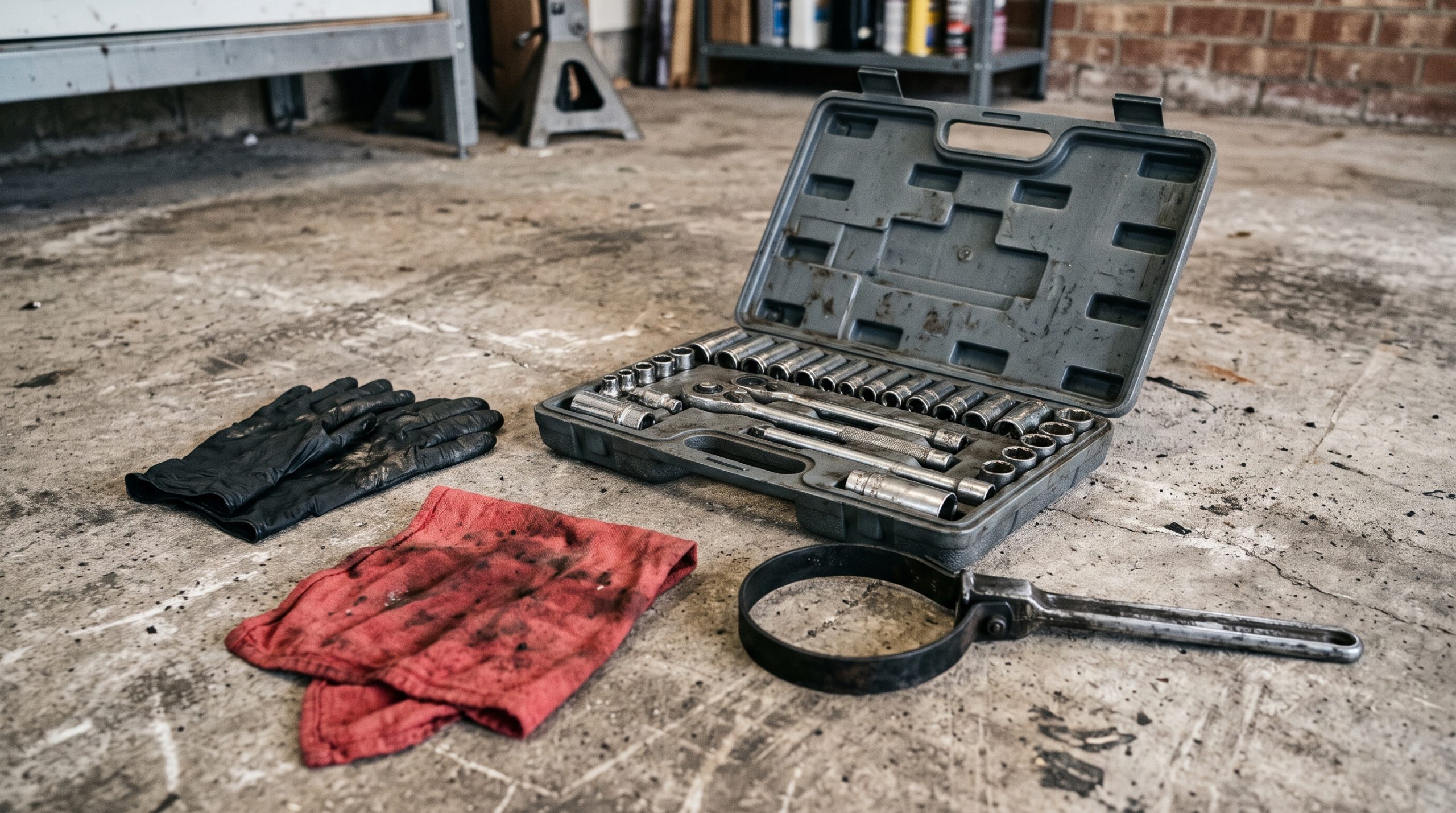
Most of these ten jobs need only a basic socket set, a jack and jack stands, and nitrile gloves. Many car owners already own these tools, or can buy them once and reuse them on every future job.
Two jobs call for something specific. Brake pads need a C-clamp or pad spreader to push the caliper piston back, a $15 one-time purchase. Spark plugs need a torque wrench, since over-tightening or cross-threading is exactly the mistake that turns a $142 savings into a $38 loss.
Skip any job that needs a tool you will only use once. The exception is a job whose shop total is high enough to absorb that cost and still leave real savings on the table.
The same cheapest-first logic applies off this list too. Before paying a shop to chase a bigger repair, work through the cheaper causes of a heater blowing cold air first, since a $0 coolant check can rule out a problem that would otherwise get misdiagnosed as a $2,000 heater-core job.
The same dealer-versus-independent math shows up with a lost car key or key fob: a mobile locksmith can often beat a dealer’s quote by a wide margin on the identical job.
Frequently asked questions
What shop labor rate does this article use, and is it realistic? This article uses $120 an hour. The American Automobile Association reports that almost half of U.S. auto repair shops price labor between $120 and $159 an hour, so $120 sits at the low, conservative end of that real range, not an invented number.
Which car maintenance jobs save the most money when you do them yourself? Brake pads save the most in dollar terms, about $210 per front axle at a $120 hourly shop rate. Cabin air filters, batteries, and spark plugs also save $49 to $142, since shops charge for both labor time and marked-up parts on each job.
Which jobs can end up costing more to do yourself? Spark plugs, batteries, and headlight bulbs carry the most risk. A cross-threaded spark plug, a reversed battery cable, or a cracked headlight housing each trigger a repair. That repair costs $38 to $270 more than the shop would have charged for the original job.
Do I need special tools before starting any of these jobs? Most of these ten jobs need only a basic socket set, a jack and stands, and gloves. Brake pads also call for a C-clamp or pad spreader, and spark plugs need a torque wrench, since over-tightening is the mistake that turns a cheap job expensive.
Leave a Reply