6 min read · Last updated November 2, 2026
- A truck carrying $3,700 in lift kit, wheels, and exhaust work can price out at exactly its stock value. Kelley Blue Book (KBB) only credits factory-installed or “factory quality” equipment.
- Reinstalling stock wheels and tires (about $390 in labor in the example here) and selling the removed parts separately nets roughly $710 more than trading in modified.
- A private sale to a buyer who wants the exact build can land about $3,200 above a trade-in or instant-offer quote, and about $2,490 above the reinstall-and-sell-separately path.
- Lift kits, oversized wheels and tires, Engine Control Unit (ECU) tuning, and aftermarket exhaust are the four modifications that most consistently show up as deductions or non-recognition in trade-in numbers.
Dealers and instant-offer tools price a modified car to its stock equivalent when you are selling it, since valuation guides like KBB only credit factory-installed or factory-quality parts. Lift kits, wheels, and tuning typically add $0 to a quote. A private sale to a buyer who wants those exact mods is the only path likely to pay for them.
In this article
- Why Dealers and Instant Offer Tools Do Not Pay for Your Mods
- Which Modifications Cost You the Most
- When Reinstalling Stock Parts Is Worth the Labor
- Pricing a Private Sale When You Are Selling a Modified Car
- Frequently asked questions
A truck carrying $3,700 in lift kit, wheels, and exhaust work can price out at the exact same number as the stock version next to it. That is what happens when you sell a modified car through a dealer’s trade-in or instant-offer tool. Kelley Blue Book is explicit about why: it only values equipment that is factory-installed or “factory quality,” so none of that spending enters the appraisal.
Why Dealers and Instant Offer Tools Do Not Pay for Your Mods
Every trade-in quote and instant-offer number starts from the same baseline. Kelley Blue Book’s own FAQ page says it directly: “We only value items which are either factory-installed or ‘factory quality.’” A lift kit, a set of 20-inch wheels, or a cold-air intake does not meet that bar, no matter what it cost you to install.
Edmunds confirms the same thing from the dealer’s side. Edmunds does not even publish a value for modified vehicles. It tells sellers that customizations will likely reduce a trade-in offer, because the dealer plans to return the car to stock condition before reselling it anyway.
That is also why the dollar amount you spent does not carry over. A system that cannot assign a line-item value to the part cannot credit the labor, the tuning file, or the exhaust note you paid for. Before picking a sale path, see the full spread between a dealer trade-in, an instant offer, and a private sale on the same car.
Which Modifications Cost You the Most
Four kinds of work show up again and again in trade-in and instant-offer numbers that land lower than owners expect.
- Lift kits. Altered ride height and suspension geometry read as non-stock to any appraiser, and a 2-to-6-inch lift is the most visible flag on the lot.
- Oversized wheels and tires. KBB will not assign them a value, and if the sizing does not match the factory spec, a reconditioning estimate often assumes they get swapped before resale.
- Tuning and Engine Control Unit (ECU) changes. A reflash or a piggyback tuner can void the factory powertrain warranty. Most appraisers have no way to confirm it has been reverted, so they discount for the uncertainty instead.
- Aftermarket exhaust. Cheap to install and cheap to remove, and the least likely of the four to move the number much in either direction once it is back to stock.
None of these are banned from a sale. They just move a build out of the price a machine can quote and into a price a person has to negotiate.
When Reinstalling Stock Parts Is Worth the Labor
Take a half-ton pickup with $3,700 in work: a lift kit for $1,450, 20-inch off-road wheels and tires for $1,850, and a cat-back exhaust for $400. Say the truck’s stock trade-in value comes back at $25,000, a number picked to make the math clean, not a live quote for any specific truck.
Trading it in exactly as built gets $25,000. The $3,700 in parts adds nothing, because the tool prices to stock either way.
Reinstalling the stock wheels and tires runs about 3 hours of labor, roughly $390 at $130 an hour. That alone does not raise the trade-in number.
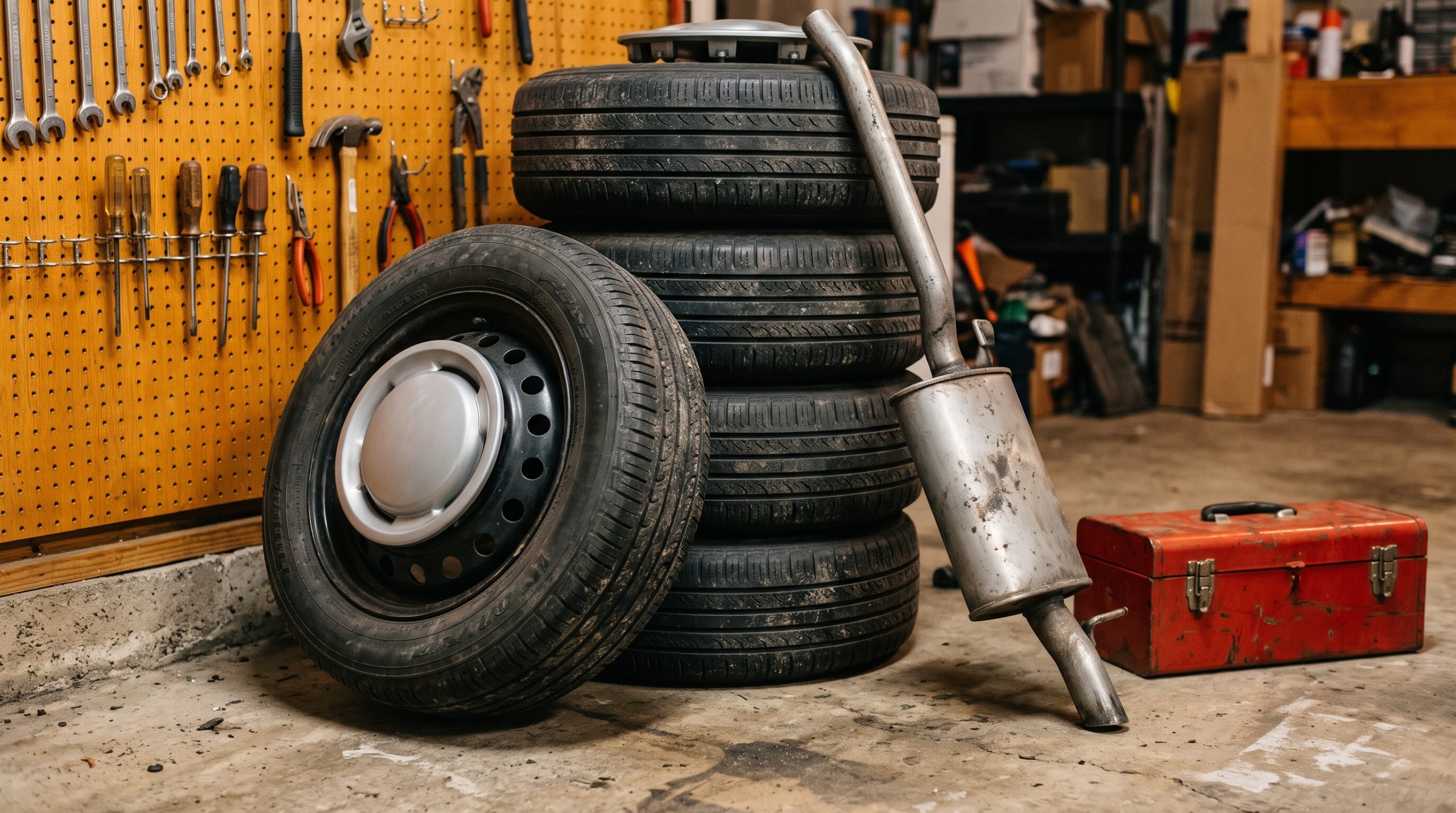
It does let you sell the lift kit and take-off wheels separately, which typically finds around $1,100 from another owner who wants those exact parts used. Net: $25,000 plus $1,100 minus $390 equals $25,710, or $710 more than trading it in modified.
A private sale to a buyer who wants the truck already built skips the labor and the parts listing. A private-party baseline here runs higher than trade-in to start, say $27,000.
A buyer who wants this specific build will often pay a premium instead of sourcing the parts themselves, say another $1,200. That is $28,200 total: $3,200 more than trade-in and $2,490 more than reinstalling and selling the parts separately.
Pricing a Private Sale When You Are Selling a Modified Car
Price the build, not just the car. Start with a private-party baseline for the stock configuration, then add the resale value of the parts themselves, not their original receipt total. A used lift kit or wheel set is worth what it would fetch on its own, not what you paid new.
List the build where the buyer already lives. Enthusiast forums, make-specific groups, and modification-friendly classifieds find your market faster than a general marketplace that assumes stock. Lead with the build sheet, brand, size, and install date the same way you would lead with mileage.
Keep every receipt and installation record. A dealer prices to stock either way, so your paperwork proves the build to a private buyer, not to an appraisal tool that was never going to credit it.
Frequently asked questions
Does a lift kit always lower a car’s trade-in value?
Usually, yes. Kelley Blue Book only credits factory-installed or factory-quality equipment, and a lift kit changes ride height and suspension geometry in a way appraisers flag as non-stock. Expect it to add nothing to a trade-in or instant-offer quote, even when the installation itself was done well and documented.
Is it worth reinstalling stock wheels before selling?
It depends on labor cost versus what the take-off parts can fetch separately. In the worked example here, about $390 in labor plus roughly $1,100 from selling the removed wheels and tires added $710 over trading in modified. Run your own numbers before assuming the swap pays for itself.
Will ECU tuning void my car’s warranty?
Tuning or reflashing the Engine Control Unit can void the factory powertrain warranty on the affected components, and most appraisers cannot confirm whether a tune has been reverted. That uncertainty usually gets priced in as a deduction rather than ignored, even on a car that drives perfectly fine.
Can I sell a modified car’s removed parts separately?
Yes, and it is often the better move financially. A dealer will rarely pay close to full value for a lift kit, wheels, or an exhaust system left on the car. An enthusiast buyer looking for exactly those used parts will often pay close to market rate directly.
Does a private sale always beat a trade-in on a modified car?
For a genuinely desirable build, usually. A buyer who wants the exact modifications will often pay a premium over a stock private-party price. A trade-in or instant-offer tool prices to stock no matter what you installed, and the trade-off for the private-sale premium is time, since private sales take longer to close.
Leave a Reply