6 min read · Last updated November 9, 2026
- A pads-only brake job runs $150 to $350 per axle. Adding rotors moves that to $250 to $500 per axle, per the American Automobile Association (AAA)’s published repair-cost guidance.
- That’s a $100 to $150 per-axle jump for rotors alone, comparing AAA’s pads-only range directly against its pads-with-rotors range.
- Every rotor carries a stamped or cast Minimum Thickness spec. Disc Brakes Australia’s technical bulletin calls it “Scrap Thickness,” the point a rotor “must be replaced.”
- Real-world spread is wide. Car Talk found a 2016 Subaru Forester rear brake job quoted at $672 by a dealer and $475 by an independent shop, for the identical pads-and-rotors scope.
A rotor belongs in a brake quote only when its measured thickness is near the stamped minimum, not because a shop decided a $150-$350 pads-only job won’t do. Ask for that reading before signing off on the extra $100-$150 rotor charge.
In this article
- What a Pads-Only Job Should Cost
- The Measurement a Shop Owes You
- A Worked Example: Reading an Actual Quote
- The Full Brake-Job Cost Ladder
- Frequently asked questions
What a Pads-Only Job Should Cost
Imagine a driver named Desmond, who brings his sedan in for a front-end squeak and expects a simple pad swap. According to AAA’s repair-cost guidance, replacing brake pads alone runs $150 to $350 per axle on a typical vehicle.
That range covers parts, labor, and a basic inspection. AAA notes the final number depends on vehicle model, regional labor rates, and whether the brake pads have already scored the rotors underneath them.
Pads-only is the right scope when the rotor’s friction surface is smooth and its thickness still sits comfortably above the minimum spec. The job gets more expensive the moment a rotor fails that check, not before.
The Measurement a Shop Owes You
Every disc brake rotor ships with a built-in limit. Disc Brakes Australia’s technical bulletin defines Rotor Minimum Thickness, also called Scrap Thickness, as “the minimum safe working thickness of a rotor at which it must be replaced.” The figure is set by the vehicle manufacturer and typically stamped or cast into the rotor hat.
The bulletin explains why the number matters mechanically. A brake rotor absorbs heat from friction and sheds it into the air. As the rotor thins, “its ability to absorb and dissipate heat is reduced,” which can show up as brake fade and longer stopping distances.
The same bulletin cites Australian Standard AS3617-1997: once a disc measures at or below that minimum after machining, “the brake disc shall be replaced.”
BMW’s own brake-rotor technical bulletin, filed with the National Highway Traffic Safety Administration, spells out how shops are supposed to use that number. New pads “may only be installed if the brake disc thickness is greater than or equal to the minimum brake disc thickness.” The stamped spec, not a visual guess, is what should decide the pads-only-versus-rotors call.
A shop that skips straight to a rotors-and-pads quote without naming a measured thickness and comparing it to the stamped minimum hasn’t actually diagnosed anything. Ask for the number before approving the extra line item.
A Worked Example: Reading an Actual Quote
Desmond’s shop comes back and says the front rotors need replacing, not just resurfacing. Before he approves it, he can check the math against two real data points.
First, AAA’s published ranges: pads-only averages $250 per axle at the range midpoint, and pads-with-rotors averages $375 per axle at its midpoint. That’s a $125 jump ($375 minus $250) attributable to the rotor work alone, and it should track with how far below spec the measured thickness actually sits.
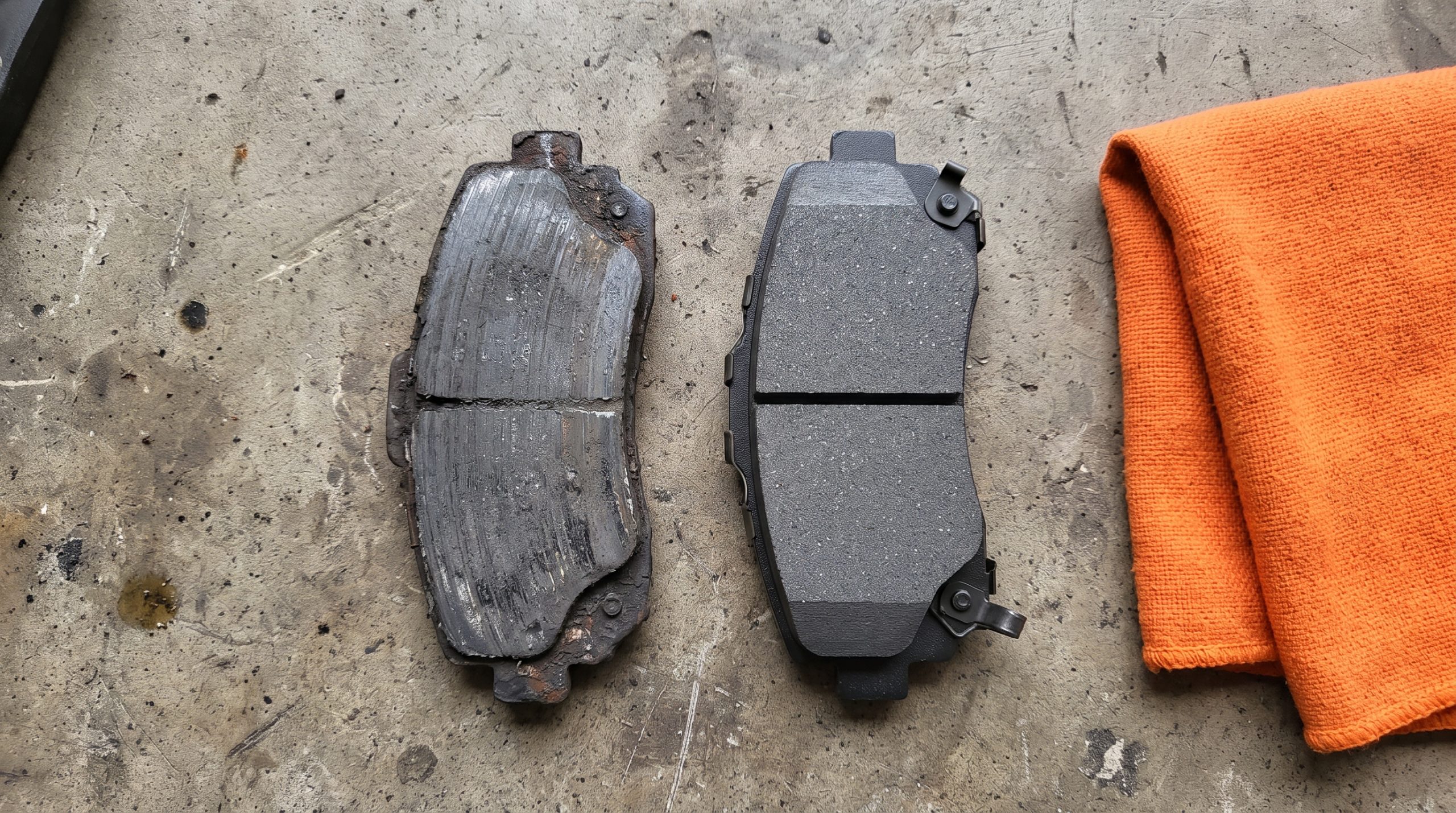
Second, Car Talk priced the identical job on two real cars. A dealer quoted $735 to replace rear rotors and pads on a 2018 Mazda CX-5, and $672 for the same job on a 2016 Subaru Forester. A local independent shop quoted roughly $475 for that Forester job, a $197 difference from the dealer price for the same parts and labor scope.
Desmond’s takeaway: a rotor upcharge in the $100 to $150 per-axle range is consistent with published data. A quote that’s double the independent-shop range, with no thickness reading offered, is worth a second opinion before he signs.
Is a Second-Opinion Diagnostic Fee Worth It? walks through when paying for a competing inspection pays for itself, a useful next step whenever a rotor quote looks steep.
The Full Brake-Job Cost Ladder
| Job scope | Typical cost | Best for |
|---|---|---|
| Pads only (per axle) | $150-$350 | Rotor thickness well above the stamped minimum, no scoring |
| Pads + rotors (per axle) | $250-$500 | Rotor scored, warped, or measured near its minimum thickness |
| Pads + rotors, one end of the car | $350-$800 | Car Talk’s published range for the same scope at higher labor rates |
| Full four-wheel pads + rotors | $500-$1,000 | Both axles measuring near minimum at the same mileage |
Labor rates explain most of the spread between AAA’s $250-$500 per axle and Car Talk’s $350-$800. A shop billing flat-rate book time at a higher hourly rate lands toward the top of either range, independent of whether the rotors genuinely needed replacing. For more on how that billing works, see Flat-Rate Book Time: What Shops Actually Bill For.
If a quote already includes other wear items near the brakes, bundling that work into one visit can be worth it. While We’re In There: When Repair Bundling Actually Saves Money breaks down when that logic holds and when it’s padding.
A rotor swap that’s genuinely warranted comes with describable evidence. Deep grooves you can feel with a fingernail, a pulsing brake pedal from warping, or a thickness reading within a millimeter of the stamped minimum all count. A quote with none of that, just a line item, is the one to question.
Frequently asked questions
How much should a pads-only brake job cost? AAA’s published guidance puts pads-only replacement at $150 to $350 per axle, covering parts, labor, and a basic inspection. The final number depends on vehicle model and local labor rates. If a shop quotes well above $350 per axle for pads alone with no unusual parts involved, ask what’s driving the extra cost.
When do rotors actually need to be replaced instead of resurfaced? Rotors need replacing, not resurfacing, once their measured thickness is at or below the Minimum Thickness stamped on the rotor, per Disc Brakes Australia’s technical bulletin. Below that point, machining isn’t an option. Australian Standard AS3617-1997 states the disc “shall be replaced” at that threshold.
How is rotor minimum thickness measured, and should I ask to see it? A technician measures the rotor’s friction surface with a micrometer and compares the thinnest reading to the number stamped or cast on the rotor hat. Yes, ask to see that reading. BMW’s own technical bulletin ties the stamped minimum directly to whether new pads can even be installed without a rotor swap.
Why did a dealer quote more than an independent shop for the same brake job? Car Talk found a dealer charged $672 for rear rotors and pads on a 2016 Subaru Forester, while a local independent shop quoted about $475 for the identical scope. Dealers typically carry higher posted labor rates and overhead, not necessarily different parts or different work.
Is it normal for a shop to recommend rotors with every pad replacement? No. AAA and Car Talk both price pads-only and pads-with-rotors as separate jobs, which only makes sense if rotors aren’t swapped on every visit by default. A shop that recommends rotor replacement every time, with no thickness reading offered, is worth questioning closely.
Leave a Reply