6 min read · Last updated October 14, 2026
- A second opinion diagnostic fee typically runs $100 to $200, about one hour of shop labor. The American Automobile Association (AAA) and PartsTech data put that rate at $120 to $159 an hour for nearly half of U.S. shops.
- Transmission replacement quotes run $2,900 to $7,100, according to Kelley Blue Book, so a wrong diagnosis in this category is the most expensive one to get wrong.
- A transmission fluid flush instead of a full replacement runs $165 to $290, according to Kelley Blue Book, which is the exact gap a second opinion exists to catch.
- Intermittent electrical faults often trace to a loose connection rather than a failed part. That’s according to a 2012 General Motors bulletin on file with the National Highway Traffic Safety Administration (NHTSA).
A second opinion diagnostic fee of $100 to $200 is worth paying whenever a wrong diagnosis could mean a $2,900 to $7,100 transmission replacement. It’s also worth it before a guessed-at electrical repair or a no-code visit that finds nothing, but rarely on a repair with a stored code and a part under $400.
A wrong transmission diagnosis can turn a $220 sensor repair into a $4,500 replacement bill. That gap is why the fee pays for itself on a transmission job, but it’s wasted on a brake repair with a clear code and a cheap part.
In this article
- When a transmission quote needs a second opinion
- Intermittent electrical faults: why the second shop might find it
- No fault code found: when a second opinion adds nothing
- A second opinion diagnostic fee decision framework
- A worked example: $150 diagnostic versus $4,500 replacement
- Frequently asked questions
When a Transmission Quote Needs a Second Opinion
If the shop ends up waiting on a backordered part while you sort out the right diagnosis, who actually covers the rental car during that wait is a separate question worth checking early.
Transmission symptoms lie. Slipping, hard shifts, and delayed engagement into gear can come from a failing clutch pack that genuinely needs a rebuild, or from fluid that’s simply low or degraded. Both can feel identical on a short test drive.
That overlap is why transmission replacement quotes run $2,900 to $7,100, according to Kelley Blue Book, while a fluid flush runs $165 to $290. If the first shop’s answer is full replacement without a fluid sample pulled or a road test under load, that’s a red flag. The gap between those two numbers is reason enough to pay a second shop for an hour of diagnostic time.
Intermittent Electrical Faults: Why the Second Shop Might Find It
Flickering interior lights, erratic exterior lights, and dashboard warning messages that come and go rarely get solved by swapping a battery or alternator on a guess. A 2012 General Motors bulletin on file with the National Highway Traffic Safety Administration (NHTSA) describes the actual fix for this pattern. A technician wiggles the suspect fuse while the vehicle runs, then checks terminal tension inside the fuse block if the fault changes.
That’s a deliberate test, not a swap-and-hope repair, and a first shop under time pressure may skip it in favor of replacing a module or battery instead. A second opinion is worth paying for here to ask one question: does the shop check connections and grounds before replacing parts? That single question separates a real diagnostic process from another guess.
No Fault Code Found: When a Second Opinion Adds Nothing
A clean scan doesn’t mean nothing is wrong, but it also doesn’t automatically justify a second opinion. The fee only earns its keep if the second shop brings something new. That could be a different scan tool, a specialty in that system, or a willingness to test under the exact conditions that trigger the fault.
If a second visit would just rerun the same basic code reader that already came back clean, skip it and save the fee. Our guide to documenting conditions before a no-code diagnostic visit covers how to make the first visit count instead of paying for a second one that repeats it.
A Second-Opinion Diagnostic Fee Decision Framework
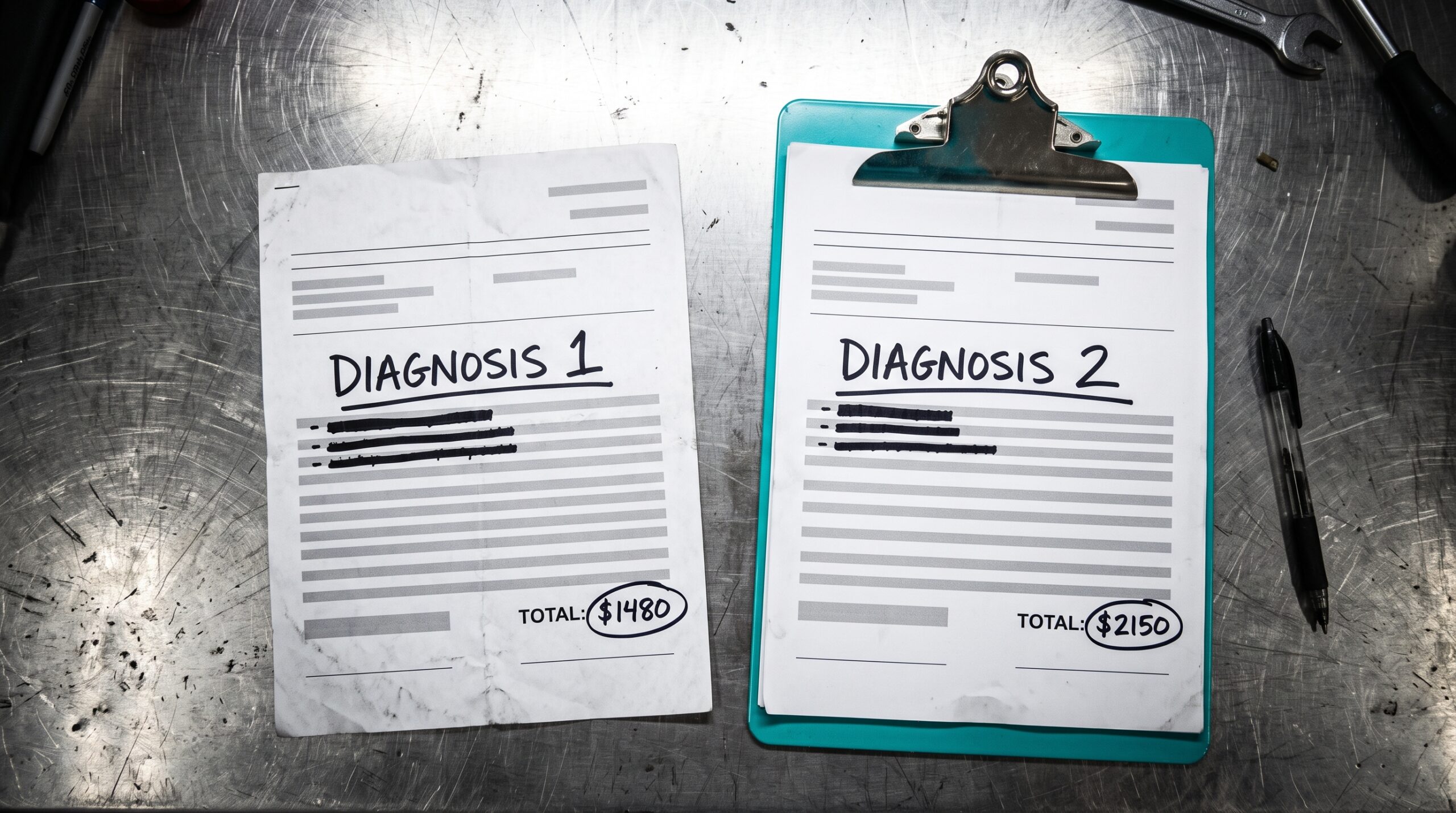
The repair category decides whether a second opinion pays for itself, not the size of the quote alone. A $150 fee on a $4,500 transmission job is trivial. The same $150 fee on a $350 starter replacement with a stored code is close to half the job’s cost.
| Repair category | Typical cost if the diagnosis is wrong | Typical second-opinion fee | Worth a second opinion? |
|---|---|---|---|
| Transmission replacement quote | $2,900 to $7,100 for a full replacement when the real fix may be a $165 to $290 fluid service | $100 to $200 | Yes, almost always |
| Intermittent electrical fault | One or more parts replaced on a guess, plus repeat diagnostic labor on top of the original charge | $100 to $200 | Yes, if the shop checks connections first |
| No fault code found | Another diagnostic charge that turns up the same nothing | $100 to $200 | Only with different equipment or specialty |
| Repair with a stored code and a simple part (battery, starter, brakes) | Typically under $400 in parts and labor | $100 to $200 | No, usually not worth it |
As AAA’s own advice puts it, a second opinion is a smart move whenever a repair is expensive or the first estimate came from little more than a quick glance.
A Worked Example: $150 Diagnostic Versus $4,500 Replacement
Take a 2016 sedan quoted at $4,500 for a transmission replacement after an intermittent slipping complaint with no stored code. A second shop charges $150 for an hour of diagnostic time, close to the $120 to $159 rate nearly half of U.S. shops charge. That shop finds a failing output speed sensor instead.
The actual fix was a $220 part and labor, for a total of $370 across both diagnostic visits, against the original $4,500 quote. That’s a $4,130 difference the $150 second opinion bought many times over. An independent specialist shop, which typically bills a lower hourly rate than a dealer, is often the right place to get that second look.
Frequently asked questions
Is it worth paying for a second opinion on a car repair? Yes, when the repair involves a transmission replacement, an intermittent electrical fault, or a diagnosis with no stored code. Those categories carry the highest risk of an expensive wrong answer. On a routine repair with a clear code and a part under $400, a $100 to $200 second-opinion fee usually isn’t worth it.
How much does a second opinion diagnostic fee cost? Most shops bill a second opinion as roughly one hour of diagnostic labor. That runs $120 to $159 an hour at nearly half of U.S. repair shops, according to AAA and PartsTech data. Expect to pay $100 to $200 total, sometimes more at a dealership.
Why do transmission repairs get misdiagnosed so often? Transmission symptoms like slipping, hard shifts, or delayed engagement can come from a failing clutch pack that needs a rebuild. They can also come from low or degraded fluid that needs only a flush. Both look similar during a quick test drive, which is why a full replacement quote deserves a second look.
What should a second shop do differently for an intermittent electrical fault? A second shop should check physical connections first: wiggling fuses, connectors, and grounds while the fault is present, rather than replacing a battery, alternator, or module on a guess. A 2012 General Motors bulletin on file with the National Highway Traffic Safety Administration describes this exact method for flickering lights and erratic electronics.
Is a second opinion worth it when the first shop found no fault code? Only if the second shop uses different equipment or expertise. If a second visit would just rerun the same basic scan that already came back clean, the fee adds cost without adding information. It’s worth paying for only when the second shop can test under conditions the first one couldn’t reproduce.
Leave a Reply