5 min read · Last updated November 18, 2026
- AAA (the American Automobile Association) recommends washing a car’s undercarriage at least every two weeks during salt season, more often right after a heavily salted storm.
- Consumer Reports sets a lower floor: once a month in snow season, and it notes a plain exterior wash usually skips the undercarriage entirely.
- AAA’s most recent nationwide survey, from 2017, put the average salt-related rust repair bill at $490. A full winter of $5 to $15 underbody washes costs far less.
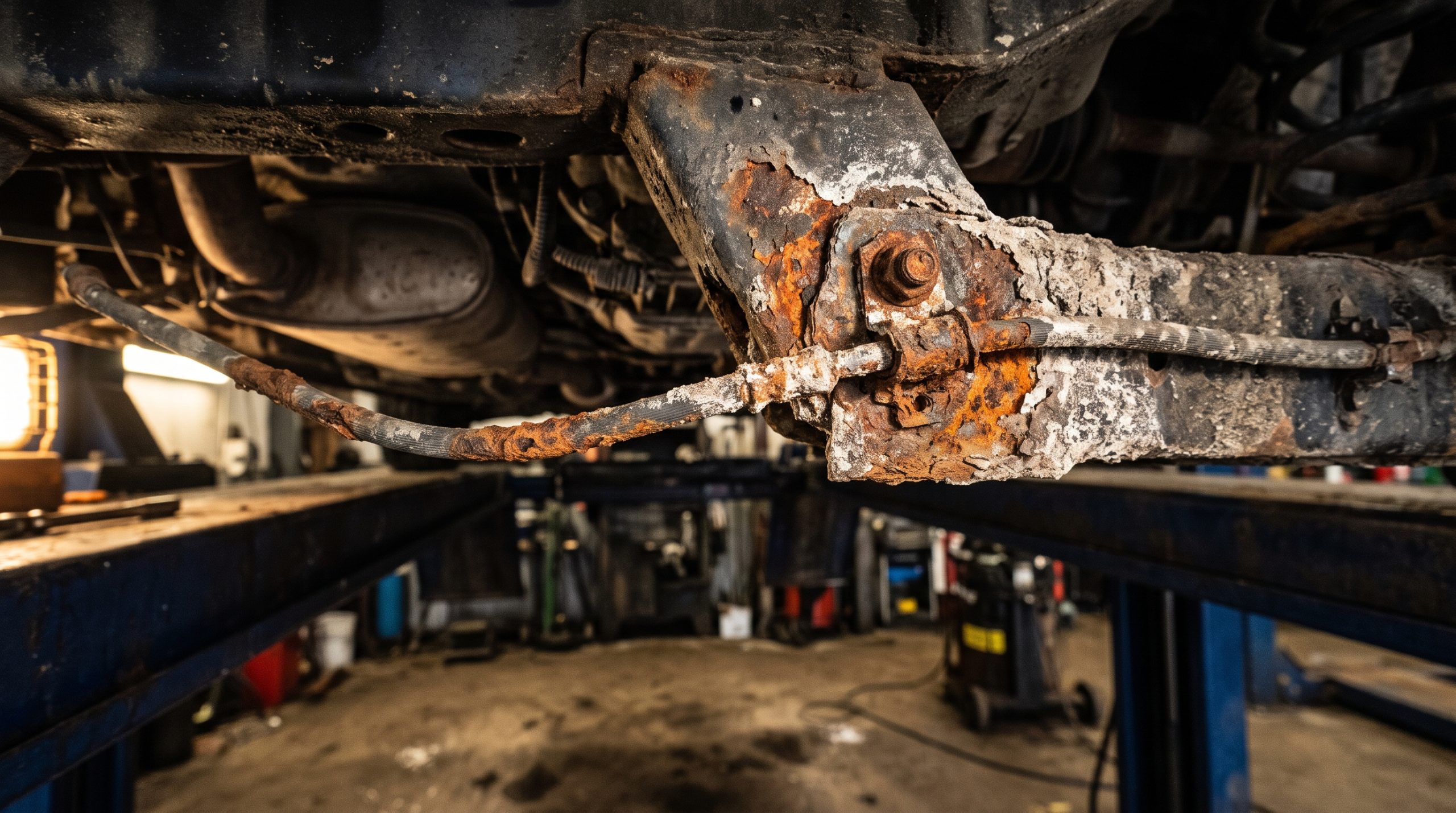
- Brake lines, suspension and subframe mounts, and exhaust hardware are the parts mechanics see fail first from salt exposure.
A winter underbody wash removes road brine from brake lines and subframe mounts before it causes pitting and leaks. AAA recommends doing this at least every two weeks in salt season, with Consumer Reports’ floor at once a month.
In this article
- The real wash schedule, not a guess
- Why a winter underbody wash has to happen on purpose
- Which parts the salt eats first
- What skipping washes actually costs
- Frequently asked questions
A loose winter wash habit is what turns ordinary road salt into a $490 repair bill. Take Teresa, a driver in Minneapolis, Minnesota, who felt her brake pedal go soft one March morning. Her mechanic found a brake line rotted through from road salt that had sat against it since January.
The real wash schedule, not a guess
AAA’s winter guidance is explicit: wash at least every two weeks once roads are being salted, and sooner than that after any storm that leaves a heavy coating. AAA treats this as preventive maintenance, not a luxury, since the group classifies rust as “normal wear and tear” that most insurance policies will not cover.
Consumer Reports sets a lower floor: once a month during snow season, more often if the car is visibly coated in salt. Either schedule beats what most owners actually do, which is to wait for a thaw and a free Saturday.
Timing also matters. Washing in the middle of a hard freeze can push water into body seams and door channels, where it refreezes. The better windows are right after a storm clears, and whenever temperatures climb back above freezing for a day or two.
Why a winter underbody wash has to happen on purpose
A standard $8 to $12 tunnel wash cleans paint and glass, but it usually does nothing for the chassis. Consumer Reports is direct about this: the underbody spray that actually reaches brake lines and the subframe is “often an added charge,” not a default part of the wash.
That add-on commonly runs another $5 to $15, depending on the wash. A real winter underbody wash pairs a touchless pre-soak, which loosens packed salt without scratching paint, with a dedicated undercarriage spray bar. Skipping that second step to save a few dollars is how brine ends up sitting against bare metal for weeks.
Which parts the salt eats first
AAA’s own warning names three categories: structural parts, brake lines, and suspension systems. All three sit low on the vehicle, stay wet longest after a storm, and on many models are built from thinner steel than the body panels on top.
Exhaust hangers and clamps corrode the same way, and a mechanic doing a winter inspection usually checks them in the same pass. None of these parts are expensive individually. A rotted hanger might run $40.

A full brake line is what turns into the $490 average AAA found in its most recent survey. The fix means replacing a sealed system, not bolting on a bracket. For how far that corrosion can run before it becomes a structural problem, see rust and frame corrosion’s real end-of-life clock.
What skipping washes actually costs
Run the math for one typical winter: a salt-belt season runs roughly 16 weeks, late November through mid-March. Washing every two weeks at a $12 underbody add-on means 8 washes.
Eight washes at $12 each comes to $96 for the season, far less than the brake-line repair that caught up with Teresa. That is less than a fifth of AAA’s $490 average salt-related rust repair bill, its 2017 survey figure and still the most recent one available. It is money spent on prevention instead of a single bad bill.
The comparison gets starker over several winters. Three winters of consistent washing runs about $288 total. Two skipped winters followed by one brake-line repair costs $490 on its own, plus whatever a shop charges to also address the subframe corrosion that usually shows up alongside it.
Drivers weighing whether other winter upkeep pays for itself can run the same kind of math against winter tires versus all-season tires.
Frequently asked questions
How often should I wash the underbody of my car in winter? Wash the underbody at least every two weeks once roads are being salted, per AAA’s guidance, and sooner after any storm that leaves a heavy coating. Consumer Reports sets a once-a-month floor if every two weeks is not realistic. Either beats waiting for a dry Saturday, since brine keeps working on brake lines the whole time it sits.
Does a regular car wash clean the undercarriage? Usually not. A standard $8 to $12 tunnel wash cleans paint and glass but typically skips the chassis. Look for a wash that lists an undercarriage spray or rust-inhibitor add-on, often $5 to $15 extra, or ask the attendant directly before you pay.
Is it okay to wash my car when it is below freezing outside? Washing during a hard freeze can push water into door seals and body seams, where it refreezes and can jam them shut. The better windows are right after a storm clears, or on the next day temperatures climb back above freezing, even briefly.
Which parts of a car does road salt damage first? AAA’s own warning names three categories: structural parts, brake lines, and suspension systems, all built from thinner steel in many spots than the body panels above them. Exhaust hangers and clamps corrode the same way and often get flagged during the same inspection.
Is underbody rust covered by car insurance? Usually not. AAA classifies salt-related corrosion as normal wear and tear, which most standard auto insurance policies exclude. A $5 to $15 wash habit is the cheaper call than waiting for a bill like the $490 figure AAA found in its 2017 survey, the most recent one available.
Leave a Reply