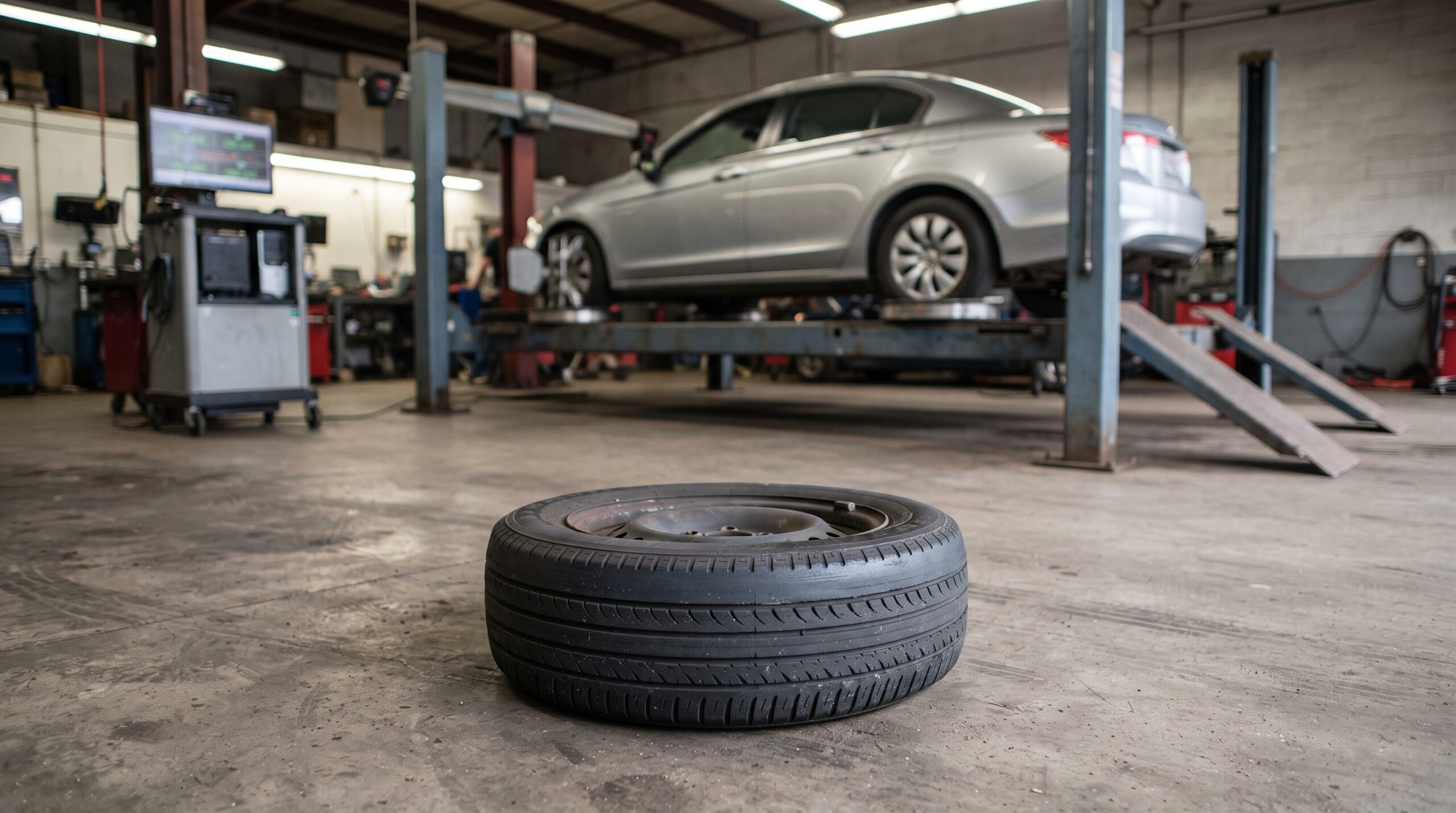
6 min read · Last updated August 21, 2026
- The American Automobile Association (AAA) puts a four-wheel alignment at $100 to $168, a small slice of what a new set of tires costs.
- A peer-reviewed toe-angle study found tire travel life dropped 33% at just 0.4 degrees of toe misalignment, far short of severe.
- Feathering points to toe, inside or outside edge wear points to camber, and a worn tie rod end or ball joint can block the alignment from holding at all.
In this article
- The wear pattern that gives away toe, camber, or caster problems
- Why some cars cannot be aligned until a suspension part is replaced first
- The $200 tread-life math behind a $110 alignment
- Frequently asked questions
Marcus paid $640 for four new all-season tires at a shop outside Tampa, then said no to the $118 alignment check because he was already late getting back to work. Eleven months and roughly 19,000 miles later, the inside edges of both front tires were worn down to the wear bars while the center tread still had more than half its depth left. The shop’s diagnosis was toe misalignment that had been quietly eating tread since the day the new tires went on. The $118 Marcus skipped did not disappear. It came back attached to an early, unplanned trip to buy a second set of tires.
The wear pattern that gives away toe, camber, or caster problems
An alignment adjusts three angles, and each one leaves its own signature on the tread. Toe is how far the tires point inward or outward when viewed from above. According to Bridgestone’s official tire alignment guide, toe problems cause feathering, where “the tread is smooth on one side and sharp on another” when you run a hand across it. Camber is how far a tire tilts inward or outward when viewed from the front, and camber problems wear the inside or outside shoulder of the tread noticeably faster than the center. Caster is the angle of the steering axis viewed from the side. It mostly shows up as a car that pulls to one side or feels loose returning to center, rather than a distinct tread pattern. AAA describes the camber effect in almost the same words: a misaligned tire “will wear more heavily on the inside or outer edges,” and that uneven tread “shortens tire life” outright, not just its appearance.
| Angle | What it controls | Wear or symptom it produces |
|---|---|---|
| Toe | Tires pointing in or out, viewed from above | Feathering: smooth on one edge, sharp saw-tooth ridges on the other |
| Camber | Tire tilt in or out, viewed from the front | Inside or outside shoulder worn faster than the center tread |
| Caster | Steering axis angle, viewed from the side | Pulling to one side or a loose, wandering steering feel |
Any of these patterns showing up early is also a signal worth checking against the tire’s rated mileage, the same math covered in how tread rating and cost per mile actually work.
Why some cars cannot be aligned until a suspension part is replaced first

An alignment machine adjusts angles by turning bolts and cams on parts that are assumed to be solid. Tie rod ends, ball joints, and control arm bushings are the parts that actually hold those angles in place once the car is back on the road. Bridgestone’s guide notes that “worn bearings, ball joints, and other wheel-suspension parts may contribute to camber misalignment,” and the same logic applies to toe through a worn tie rod end. If a technician puts the car on the rack and finds play in one of those joints, dialing the numbers to spec does nothing useful. The angle will not hold once the car leaves the shop, because the loose part keeps shifting it back out. That is why a $110 alignment quote can turn into a $110 alignment plus a tie rod end, a ball joint, or a bushing. A shop will quote and replace the worn part before it touches the alignment rack at all. It is not an upsell attempt. A shop that skips this step and adjusts the angles anyway hands back a car that drifts out of spec again within a few thousand miles, which wastes both the alignment fee and the visit.
The $200 tread-life math behind a $110 alignment
Here is the arithmetic behind why the alignment line item is worth paying. Say a set of four tires costs $600 total ($150 each) and carries a 60,000-mile tread life rating, a typical range for mainstream all-season tires. A 2024 peer-reviewed study in the Journal of Engineering measured tire travel life at different toe-in angles. At just 0.4 degrees of toe misalignment, well short of the range the study calls severe, tire travel life fell 33%, from 92,250 km down to 61,500 km in controlled testing. Apply that same 33% loss to the example set: 60,000 miles of rated life becomes about 40,000 miles of real life, a loss of 20,000 miles. At $600 for 60,000 miles, each mile of tread is worth $0.01. Twenty thousand wasted miles times $0.01 per mile equals $200 in tread paid for but never driven on. That $200 loss, on one set of tires, is nearly double the $100 to $168 an alignment costs according to AAA. It also is not a one-time loss. It repeats every time a misaligned car gets a new set of tires, which is exactly the pattern Marcus fell into.
Alignment is not the only thing quietly working against a new set of tires. Age does the same job independent of mileage, which is why it is worth checking how tire age vs tread depth plays into a replace-or-keep call even on a tire that still measures plenty of tread.
Rotation and alignment also solve different problems, so paying for one is never a substitute for the other. The decision rule for when to pay for each comes down to the wear pattern on the tire, not the calendar.
Frequently asked questions
Does a car really need an alignment every time new tires go on? Not always, but it should be checked. If the last alignment was within about 6,000 miles and there is no uneven wear, pulling, or recent pothole or curb hit, some shops will verify the angles are still in spec instead of doing a full paid adjustment.
How much does a wheel alignment actually cost? AAA documents four-wheel alignments running $100 to $168 nationally, depending on the vehicle and local labor rates. Front-only alignments usually cost less than a full four-wheel adjustment, but most shops recommend the full adjustment after a new set of tires goes on.
What tire wear pattern means the car needs an alignment now? Feathering, tread that feels smooth running a hand one direction and sharp the other way, points to a toe problem. One shoulder of the tread wearing faster than the center points to camber. Either pattern means an alignment check is overdue.
Can a shop refuse to do the alignment I paid for? Yes, if they find excessive play in a tie rod end, ball joint, or bushing during the pre-alignment inspection. The angle will not hold with a worn part in the way, so the part gets quoted and replaced first, then the alignment is performed.
Leave a Reply