
5 min read · Last updated October 12, 2026
- Toyota’s 2026 Camry guide sets the first engine coolant change at 100,000 miles or 120 months, not the 150,000-mile ceiling some “long life” coolant marketing implies.
- Mixing an OAT (Organic Acid Technology) coolant with an IAT (Inorganic Additive Technology) coolant can trigger additive dropout, turning the fluid into a clogging gel.
- A coolant test strip’s pH pad catches acidic, depleted coolant years before a mileage sticker says a flush is due.
- A flush priced around $150 is cheap insurance against a radiator, heater core, or water pump repair that commonly runs into four figures.
Toyota’s 2026 Camry maintenance guide sets the first engine coolant change at 100,000 miles or 120 months, not the 150,000-mile figure some “long life” marketing implies. A test strip reading acidic coolant before that point means it is due now, regardless of the odometer.
In this article
- The real coolant service interval beats the marketing claim
- Why mixing coolant types turns it into gel
- How to read a coolant test strip
- What a $150 flush actually prevents
- Frequently asked questions
A “long life” label does not set your real coolant service interval. Toyota’s own schedule calls for a change at 100,000 miles, 50,000 miles sooner than the 150,000-mile number in long-life coolant marketing.
The real coolant service interval beats the marketing claim
Toyota’s 2026 Camry Warranty and Maintenance Guide lists the first engine coolant change at 100,000 miles or 120 months, whichever comes first. After that, the interval shortens to every 50,000 miles or 60 months. Toyota also names the fluid itself: Toyota Genuine Super Long-Life Coolant, a hybrid organic acid technology (HOAT) formula built on low phosphates and organic acid additives.
The 150,000-mile figure comes from a marketing ceiling, not a specific car’s schedule. The American Automobile Association (AAA) reports that HOAT coolants are typically changed every five years or 50,000 miles. AAA adds that “some automakers specify intervals as long as 10 years or 150,000 miles.”
Toyota’s real number lands in between: 100,000 miles the first time, then 50,000 miles after.
Coolant is not the only fluid where a calendar matters as much as an odometer. Brake fluid follows the same time-based pattern, degrading on the clock even at low mileage.
Why mixing coolant types turns it into gel
Coolant color is not a reliable guide to what is actually in the system. An OAT coolant and an IAT coolant fight corrosion with different inhibitor packages, and those packages do not share a chemistry.
Valvoline, a coolant manufacturer, explains that when the two mix, “the chemistry can break down and cause what’s called additive dropout.” The result, in Valvoline’s words, is that “the inhibitors fall out of suspension and form a thick, gel-like sludge.”
That gel does not stay in one place. Valvoline’s own technical notes add that the gel “can clog your radiator, heater core, and coolant passages, starving your engine of the cooling it needs.”
The fix is not a clever mixing trick. It is knowing which type is already in the system, matching it, or doing a complete flush before switching to a different one.
How to read a coolant test strip
A coolant test strip carries two pads. The first reads freeze point, which measures how much glycol remains and whether the coolant still protects against freezing and boil-over. The second reads pH, a measure of how acidic or alkaline the fluid has become.
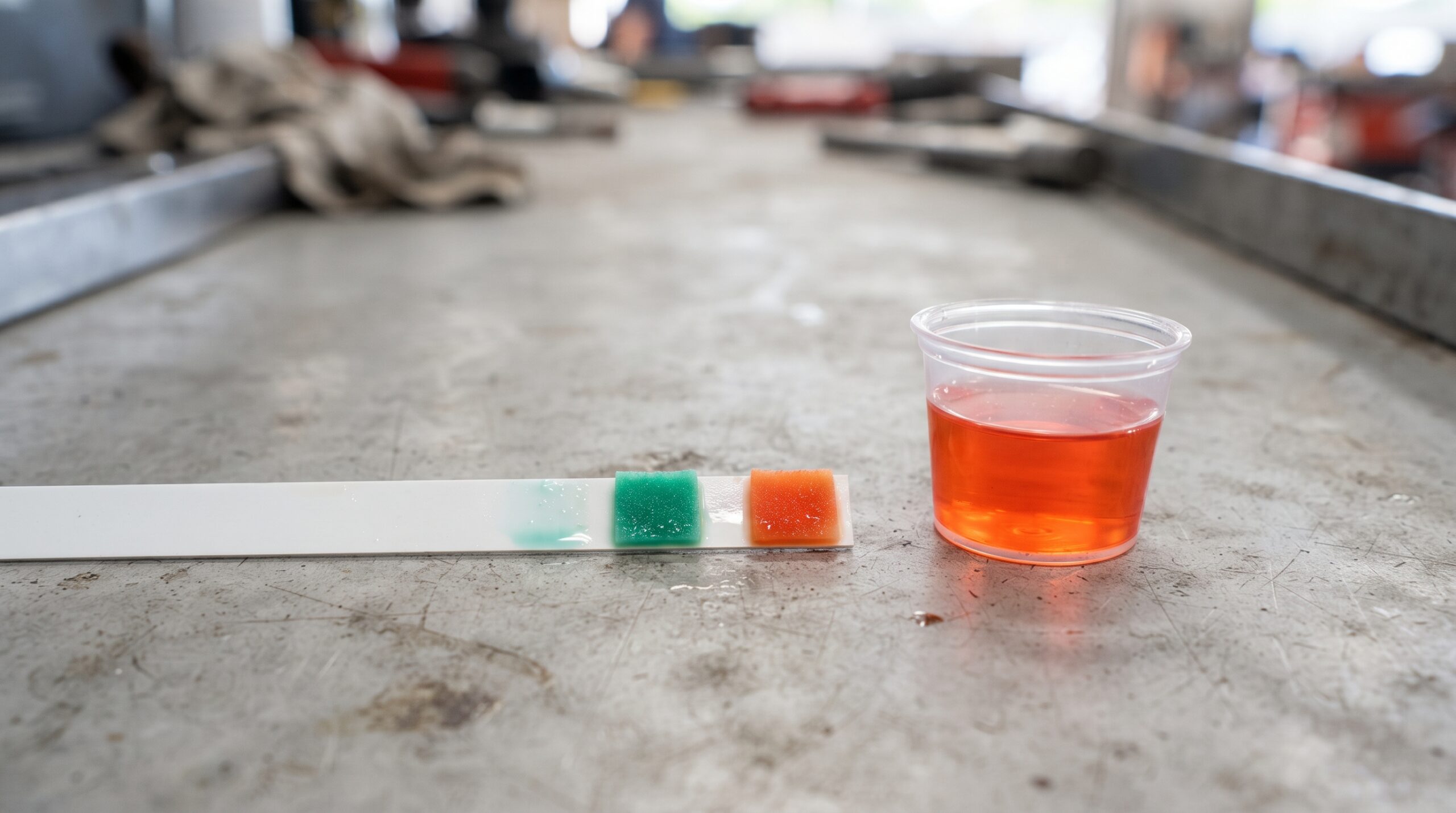
Fresh coolant sits on the alkaline side of the scale by design, buffered to resist acid formation. A reading that has drifted toward acidic means the corrosion-fighting additives are used up, even if the freeze-point pad still looks fine. That shift is the signal to flush now, not at the number printed on your last service sticker.
What a $150 flush actually prevents
A coolant flush at a quick-lube shop or independent garage commonly runs around $150 for fluid, labor, and disposal. A neglected system that corrodes or gels internally, the exact failure Valvoline warns about, typically fails bigger. A clogged radiator, heater core, or water pump repair commonly runs well into four figures once parts and labor are added up.
A corroded or gelled system is what pushes the job toward the expensive end. A water pump often fails alongside it once the system has run hot or clogged for long enough.
Waiting rarely saves money on a car repair, and cooling systems are a clear example of it.
The number to act on is simple. If a test strip shows acidic coolant before the manufacturer’s real interval, 100,000 miles on a current Camry rather than 150,000, act now.
A $150 flush beats a four-figure repair bill every time. Don’t wait for the sticker.
Frequently asked questions
Does “long life” coolant really never need changing? No, “long life” describes the coolant’s additive package, not an infinite lifespan. Toyota’s 2026 Camry guide sets the first engine coolant change at 100,000 miles or 120 months, then every 50,000 miles after that. Check your own model year’s maintenance guide, since the real interval differs by manufacturer and generation.
Can I just top off with a different color coolant? Not safely, since color does not reliably indicate chemistry and OAT and IAT formulas use incompatible additive packages. Valvoline’s own technical guidance warns that mixing them can cause “additive dropout,” turning the coolant into a clogging gel that can block the radiator and heater core. Match the type already in the system.
What does an acidic test strip reading actually mean? It means the corrosion-fighting additives in the coolant are depleted, even if the freeze-point pad still looks normal. Fresh coolant starts alkaline by design. A pH shift toward acidic is the signal to flush the system now, regardless of the mileage or year printed on your last service sticker.
How much does ignoring a bad test strip actually cost? A flush commonly runs around $150. A neglected system that corrodes or gels internally often ends in a radiator, heater core, or water pump repair that runs well into four figures. The $150 flush is the cheaper outcome by a wide margin.
Is a coolant flush the same as topping off the reservoir? No. Topping off only adds volume; it does not remove the depleted or contaminated fluid already circulating. A real flush drains the old coolant, clears the passages, and refills with the correct type at the correct concentration, which is what actually resets the service interval.
Leave a Reply