6 min read · Last updated August 12, 2026
- Federal rule 49 CFR 571.116 sets a minimum dry boiling point of 401°F (205°C) for new DOT 3 brake fluid, but that number drops as the fluid absorbs moisture from the air, whether the car is driven or parked.
- AAA classifies “brake fluid doesn’t need to be changed” as a maintenance myth and recommends a two- to three-year replacement interval regardless of mileage.
- Toyota’s own service guidance splits coolant into two tracks: standard silicate coolant on a 2-year/30,000-mile schedule, and extended-drain (OAT) coolant good for 5 years/100,000 miles. The type in the radiator sets the real deadline, not the odometer.
- Both fluids fail the same way: gradually, with no dashboard warning, until a hard stop or a hot day exposes the problem at the worst possible time.
In this article
- Why moisture is the real clock on brake fluid
- Why coolant runs on two different clocks
- The two-fluid calendar, worked out
- What skipping it actually risks
- Frequently asked questions
A 2023 sedan with 22,000 miles on the odometer looks freshly broken in on every other line of the maintenance schedule. Oil, tires, and the transmission service all still show thousands of miles of room to spare. Brake fluid and coolant don’t work that way. Both are already partway through their service life at 22,000 miles, and neither one is tracking the number on the dash.
Why moisture is the real clock on brake fluid
Federal rule 49 CFR 571.116 requires new DOT 3 brake fluid to have a dry boiling point of at least 401°F (205°C), and that number drops the longer the fluid sits in the lines. Brake fluid is hygroscopic, pulling moisture out of the air even inside a sealed system, and AAA lists “brake fluid doesn’t need to be changed” as a straightforward maintenance myth, recommending a two- to three-year interval no matter the mileage. For the mechanism in more depth, what a preventive flush actually costs versus what skipping it can cost instead, and how that interval differs by automaker, see the full cost breakdown here.
Why coolant runs on two different clocks
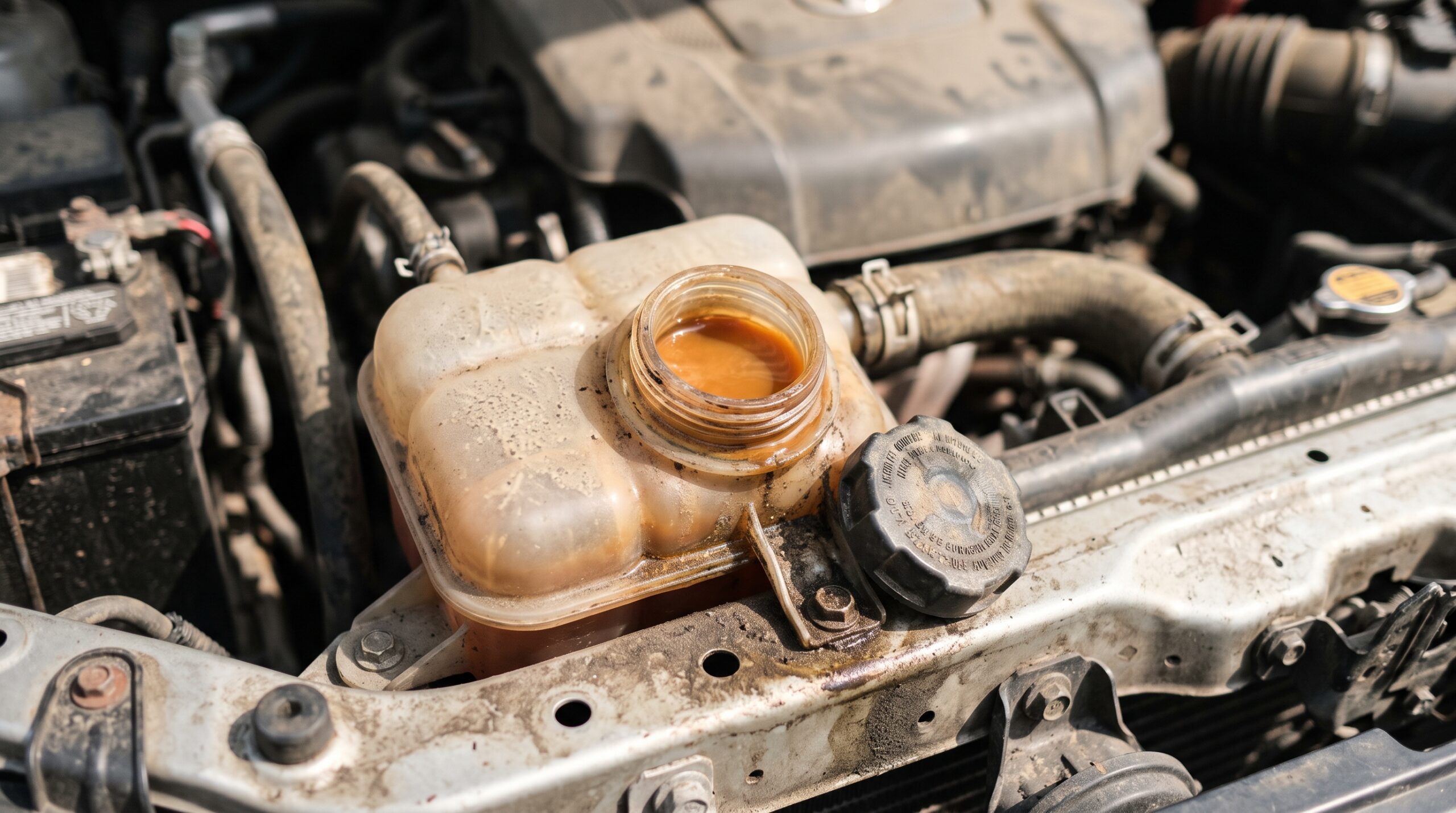
Coolant’s aging mechanism is different but the lesson is the same. Toyota’s own maintenance guidance splits coolant into two categories with two different intervals. Standard silicate-based coolant, the kind that runs green, is rated for two years or 30,000 miles. Extended-drain coolant using Organic Acid Technology, usually gold or orange, is rated for five years or 100,000 miles. Either way, the corrosion inhibitors mixed into the fluid deplete on a chemical clock that runs whether the engine turns over or not. A car that sits in a garage for three years still loses those inhibitors at close to the same rate as one that’s driven daily, which is why “it barely has any miles on it” doesn’t buy coolant any extra time. One current example shows how wide that marketing gap can get: Toyota’s own schedule pegs the real interval at 100,000 miles, well short of the 150,000-mile ceiling some “long life” coolant labels imply.
| Fluid | Time-based interval | Mileage cap | What actually triggers replacement |
|---|---|---|---|
| DOT 3 brake fluid | 2 to 3 years | Not mileage-tracked | Moisture absorption drops the boiling point below a safe margin |
| Silicate engine coolant | 2 years | 30,000 miles | Corrosion inhibitors deplete on both a time and a mileage clock |
| Extended-drain (OAT) coolant | 5 years | 100,000 miles | Same depletion mechanism, slower formula |

The two-fluid calendar, worked out
Here’s what that looks like on an actual timeline. A car bought new in January 2024 with standard silicate coolant needs that coolant changed by January 2026, or at 30,000 miles, whichever arrives first; most owners hit the two-year mark before the mileage cap unless they’re driving well over 15,000 miles a year. Brake fluid on the same car is due somewhere between January 2026 and January 2027, on AAA’s two-to-three-year window, regardless of what the odometer reads on either date. If that same car had come from the factory with extended-drain OAT coolant instead, the coolant date pushes out to January 2029, or 100,000 miles, while the brake fluid clock stays exactly the same, because brake fluid’s moisture problem doesn’t care what kind of coolant is in the radiator. The two fluids share a maintenance sticker but never share a deadline.
What skipping it actually risks
Skip the brake fluid and the failure mode is safety: a soft or fading pedal precisely when you’re braking hardest, which is the worst possible place to discover it. Skip the coolant past its interval and the failure mode is cost: depleted inhibitors let corrosion start inside the block, heater core, and radiator, turning a routine flush into a repair bill for a leak or an overheating engine. Neither fluid gives a dashboard warning before it fails; both are checked and changed on a routine oil change or tire rotation visit, which is the easiest way to stay ahead of a clock the odometer can’t see. If you’ve been told a fluid is “lifetime” and left it alone because of that word, it’s worth understanding what lifetime actually means on a maintenance sticker before you apply the same assumption to your brakes. A differential or transfer-case fluid on an AWD or 4WD vehicle has the identical no-warning-light problem, and it’s just as easy to miss on the severe-service table.
Frequently asked questions
How do I know if my coolant is silicate or long-life (OAT)? Color is the fastest clue: silicate coolant usually runs green, while OAT and HOAT extended-drain formulas run gold, orange, or pink. Your owner’s manual will state the exact type and interval for your specific model, since colors aren’t standardized across every manufacturer.
What happens if I never change my brake fluid? Moisture keeps accumulating and the boiling point keeps dropping. Eventually hard or repeated braking can cause the fluid to boil inside the lines, creating a soft or fading pedal at the exact moment you need full stopping power, along with corrosion risk to calipers and lines over time.
Can I mix old coolant with a new, different type? No. Mixing silicate and OAT formulas can cause a gel-like reaction that clogs cooling passages. If you don’t know what’s already in the system, a full flush before adding new coolant is the safer move rather than topping off.
Does a dealership automatically flush brake fluid during routine service? Not always. Many standard service menus cover oil and filters but treat brake fluid and coolant as separate line items you have to ask about or approve. Check your specific maintenance schedule by mileage and age, and confirm what a routine visit actually includes before assuming it’s covered.
Is brake fluid part of a routine oil change? No. An oil change typically checks fluid levels but doesn’t flush or replace brake fluid unless you specifically request or approve that service, since it requires bleeding the brake lines rather than draining a reservoir.
Leave a Reply