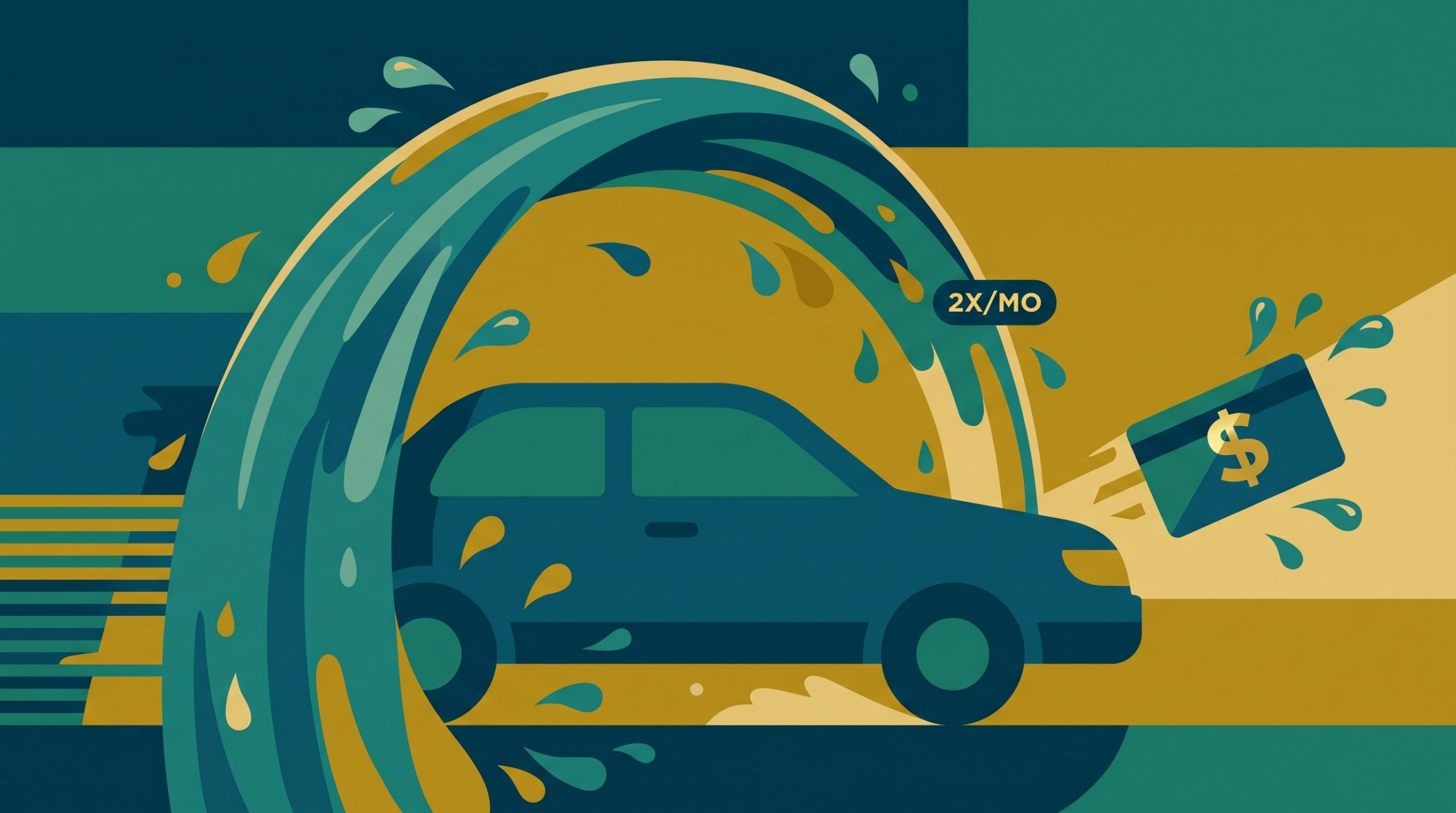
6 min read · Last updated November 4, 2026
- The American Automobile Association (AAA) recommends washing your vehicle about every two weeks during winter, more often after a storm, with the undercarriage included every time.
- At a $15 pay-per-wash price and a $25 monthly membership, two pay-per-wash visits already cost more than the whole month of unlimited washing.
- AAA’s 2016 survey put the average rust repair at $490, the kind of bill an underbody rinse exists to prevent.
- Confirm a membership’s underbody rinse runs on every visit, not just as a paid add-on, before you sign up.
At a $15 pay-per-wash price and a $25 monthly membership, two paid visits a month already cost more than the membership. Only a wash with an underbody rinse reliably clears the road salt collecting beneath the car each winter.
In this article
- Unlimited car wash membership vs pay-per-wash: the break-even math
- How often you actually need an underbody rinse in salt-belt winter
- What skipping the rinse can cost in rust repair
- Which option fits your winter driving
- Frequently asked questions
An unlimited car wash membership pays for itself once you wash your car twice in a month. Two pay-per-wash visits at a typical $15 price already cost more than most $25 monthly plans.
In a salt-belt winter, that crossover usually arrives inside the first two weeks on its own. AAA recommends washing every two weeks, and again after any storm that drops fresh salt.
Unlimited car wash membership vs pay-per-wash: the break-even math
Exact prices vary by chain and region, and neither major national chain publishes one fixed national rate. The figures below are a realistic illustrative range, not one verified chain’s live price.
A basic exterior wash with an underbody rinse commonly runs around $15 per visit at tunnel-style chains. An entry-level unlimited membership commonly runs around $25 a month. Check your own local chain’s posted price before you commit, since both numbers move by market.
| Factor | Unlimited membership | Pay-per-wash |
|---|---|---|
| Price structure | Flat $25 a month, unlimited visits | $15 per visit, pay as you go |
| Cost at 2 washes a month | $25 | $30 |
| Cost at 4 washes a month | $25 | $60 |
| Underbody rinse | Usually included every visit | Often a paid add-on; confirm before you pay |
| Commitment | Monthly plan, cancel anytime at most chains | None |
| Best for | Drivers who wash twice a month or more, or want salt off within days of a storm | Drivers who wash once a month or less |
Run the actual math. One wash in a month costs $15 pay-per-wash against $25 for the membership, so a single occasional wash favors paying per visit. Two washes in a month cost $30 pay-per-wash (2 times $15) against the same flat $25, so the membership is already $5 cheaper.
Three washes push pay-per-wash to $45 against $25, a $20 gap. Four washes push it to $60 against $25, a $35 gap.
The break-even point sits between the first and second wash. $25 divided by $15 equals 1.67 washes, so the second wash of the month is where membership starts winning outright.
How often you actually need an underbody rinse in salt-belt winter
AAA’s guidance says washing a vehicle every two weeks during winter, and more often after heavy snowfall, is a good rule of thumb. It calls a wash that includes undercarriage cleaning essential.
That’s roughly the pace an unlimited membership is built for. A pay-per-wash driver hitting that same every-two-weeks schedule would spend $30 a month, already above the illustrative $25 membership price.
The National Highway Traffic Safety Administration (NHTSA) is the federal agency that oversees vehicle safety recalls and service bulletins. It has posted manufacturer service bulletins specifically instructing dealers to give the undercarriage a dedicated wash whenever it carries significant road salt residue.
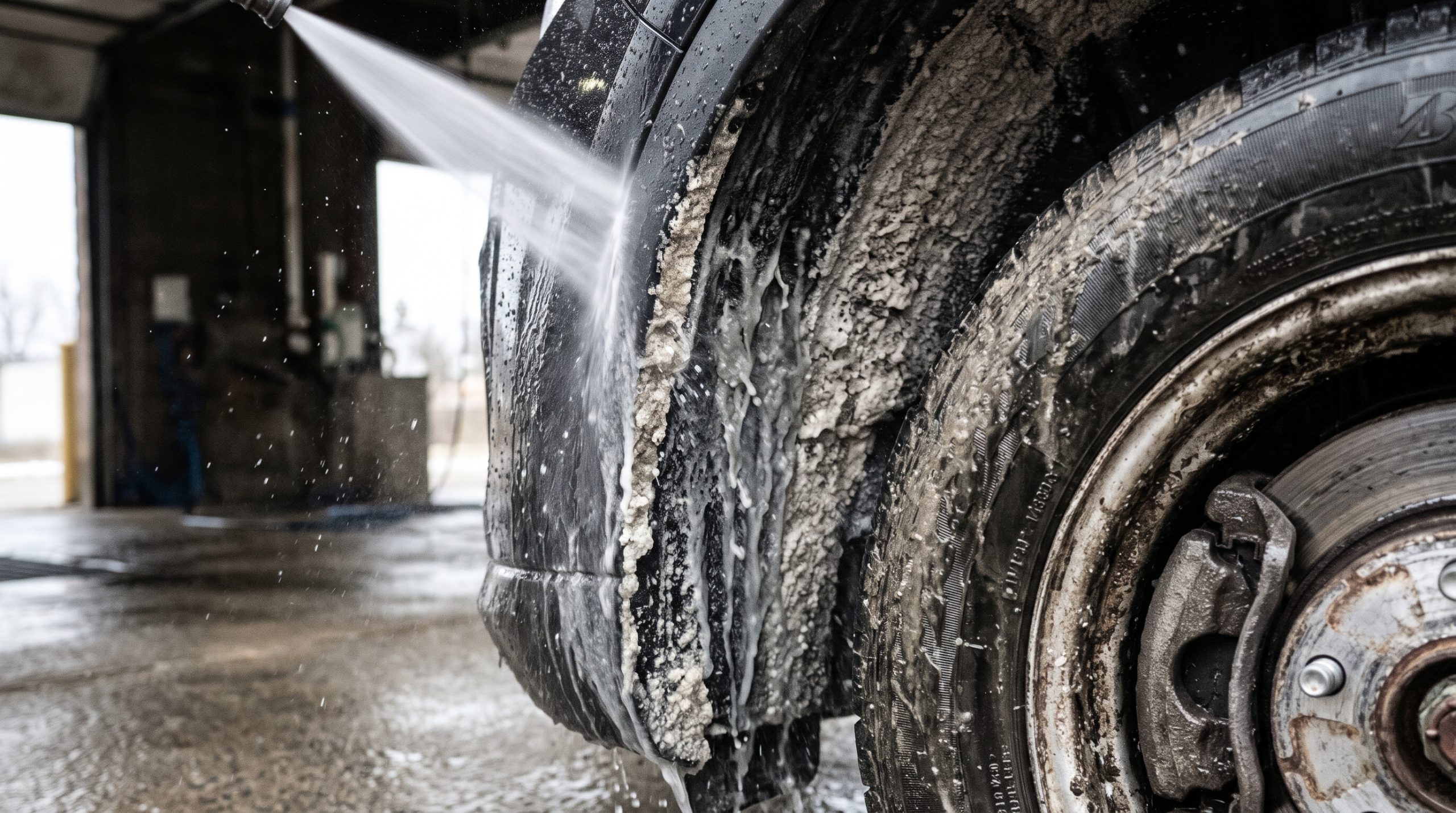
That instruction exists because salt left sitting on brake lines and metal underbody components causes the corrosion. The salt that gets rinsed off the paint on top is not the mechanism.
What skipping the rinse can cost in rust repair
AAA’s own 2016 survey found that among drivers who had at least one rust-related repair, the average repair cost $490. That figure is nearly a decade old, so a comparable repair today likely runs higher. A separate breakdown of whole-season undercoating economics, including how that $490 figure plays into a different break-even calculation, is in our undercoating cost piece.
A wash membership isn’t rustproofing on its own. It’s a cheap, repeatable habit that keeps salt from sitting on the metal long enough to start the corrosion AAA is describing. Skipping washes all winter doesn’t guarantee a $490 bill, but it removes the one low-cost step that reliably delays it.
Which option fits your winter driving
If you drive through salted roads at least twice a month, the membership wins on cost. It also wins on consistency if you want the undercarriage rinsed within days of every storm.
If you drive occasionally, or keep the car garaged most of the winter, pay-per-wash costs less over the same stretch. This same question, how much salted winter driving your car actually sees, is also what decides whether winter tires are worth pricing against all-seasons.
Frequently asked questions
Does a basic pay-per-wash include the underbody rinse? Not always. Many entry-level pay-per-wash options clean the exterior paint and windows but treat the underbody or undercarriage rinse as a separate add-on charge. Before you decide pay-per-wash is cheaper, check whether the price you’re comparing actually includes the undercarriage pass, since that’s the part road salt makes worth paying for.
How often should I wash my car if I don’t get a membership? AAA recommends washing about every two weeks during winter, and again after any storm that puts down fresh salt. Without a membership, that pace runs roughly $30 a month at a $15 per-wash price, which is already more than many unlimited plans cost for the same frequency.
Can I cancel a car wash membership once winter ends? Most chains run memberships month to month with no long-term contract, so you can typically cancel once salted roads stop being a daily issue in spring. Confirm the cancellation process before signing up, since some locations require canceling in person or through a specific online portal rather than a phone call.
Does washing my car actually prevent rust, or just make it look clean? Regular washing, especially an underbody rinse, removes the salt before it sits on metal long enough to corrode it. AAA’s own guidance ties undercarriage washing directly to preventing the rust damage its 2016 survey measured at a $490 average repair. It won’t undo rust that’s already started, but it slows new corrosion.
What if my local chain’s membership costs more than $25 a month? Run the same math with your actual local price. Divide the monthly membership price by your area’s pay-per-wash price to find your own break-even wash count. A $30 membership against an $18 wash still breaks even under two visits a month; the specific numbers change, the method doesn’t.
Leave a Reply