6 min read · Last updated August 10, 2026
- The Federal Trade Commission (FTC)’s consumer guide confirms flat-rate shops bill “an independent or manufacturer’s estimate of the time required,” not the technician’s actual clock time. A 2.4-hour book job bills the same whether the tech takes 70 minutes or 3 hours.
- Mitchell 1, one of the labor-time guides most U.S. shops have run off since 1946, builds its “book time” from confidential, decades-long time studies, not from any one technician’s speed.
- California’s Bureau of Automotive Repair requires a written estimate before work starts, and a shop generally can’t bill past it without your separate authorization (Cal. Code Regs. tit. 16, Section 3353).
- The Bureau of Labor Statistics (BLS)’s price index for motor-vehicle maintenance and repair rose 7.0% between June 2025 and June 2026. Book time itself isn’t creeping up. What a shop can charge per hour against it is.
In this article
- What flat rate actually means
- Where the hours in the book come from
- The math on your own invoice
- Your rights when the estimate and the bill don’t match
- Frequently asked questions
Your invoice lists 2.4 hours of labor for a water pump job the technician finished in about 70 minutes, and the shop hasn’t done anything wrong.
What flat rate actually means
The Federal Trade Commission’s consumer guide to auto repair lays out the two billing models plainly: “Some shops charge a flat rate for labor on auto repairs. This published rate is based on an independent or manufacturer’s estimate of the time required to complete repairs. Others charge on the basis of the actual time the technician worked on the repair.” Most dealers and larger independent shops use flat rate. It prices the same job the same way no matter which technician on staff does the work. Smaller independent garages are more likely to bill actual clock time, though many use a hybrid depending on the job.
In plain terms: the “2.4 hours” on your invoice usually isn’t a record of anything that happened in your bay. It’s a number pulled from a published guide before the technician ever touched your car.
Where the hours in the book come from
Mitchell 1, one of the labor-time guides most U.S. dealers and independent shops run off, has been publishing these estimates since 1946. The company calls its own process “strictly confidential and proprietary.” It says the estimates apply “hundreds of years of collective industry experience, time studies and industry interactions.” AllData is the other major guide shops use, and some manufacturers publish their own factory labor times too. All of them are built the same way. Each one represents an average technician working under average shop conditions on an average example of that repair, not the specific person and specific car in front of you.
That’s why a veteran technician who’s done the same water pump job five hundred times can beat book time every day. A technician fighting a rusted bolt on an older car can just as easily run over it. The book doesn’t know either thing happened. The book does know when a second repair shares the same teardown as the first, and that overlap is exactly what makes a bundled “while we’re in there” repair cheaper than two separate visits, at least when the overlap is real.
The math on your own invoice
Here’s the arithmetic, using a common shop rate of $150 an hour as the example. Posted rates vary by shop and region, so swap in your own invoice’s rate to redo this math. Book time for the water pump: 2.4 hours. Billed labor: 2.4 x $150 = $360. Actual time on the lift: 70 minutes, or 1.17 hours. If the shop billed actual time at the same rate instead: 1.17 x $150 = $175.50. The gap, $184.50 on this one job, is the flat-rate system working exactly as designed, not an error on your bill. Labor book time is usually the single biggest number on that invoice, but it is rarely the only one worth checking — the shop-supplies and hazmat fees stacked below it deserve the same scrutiny, and so does a small add-on like a cabin air filter swap riding along on the same ticket.
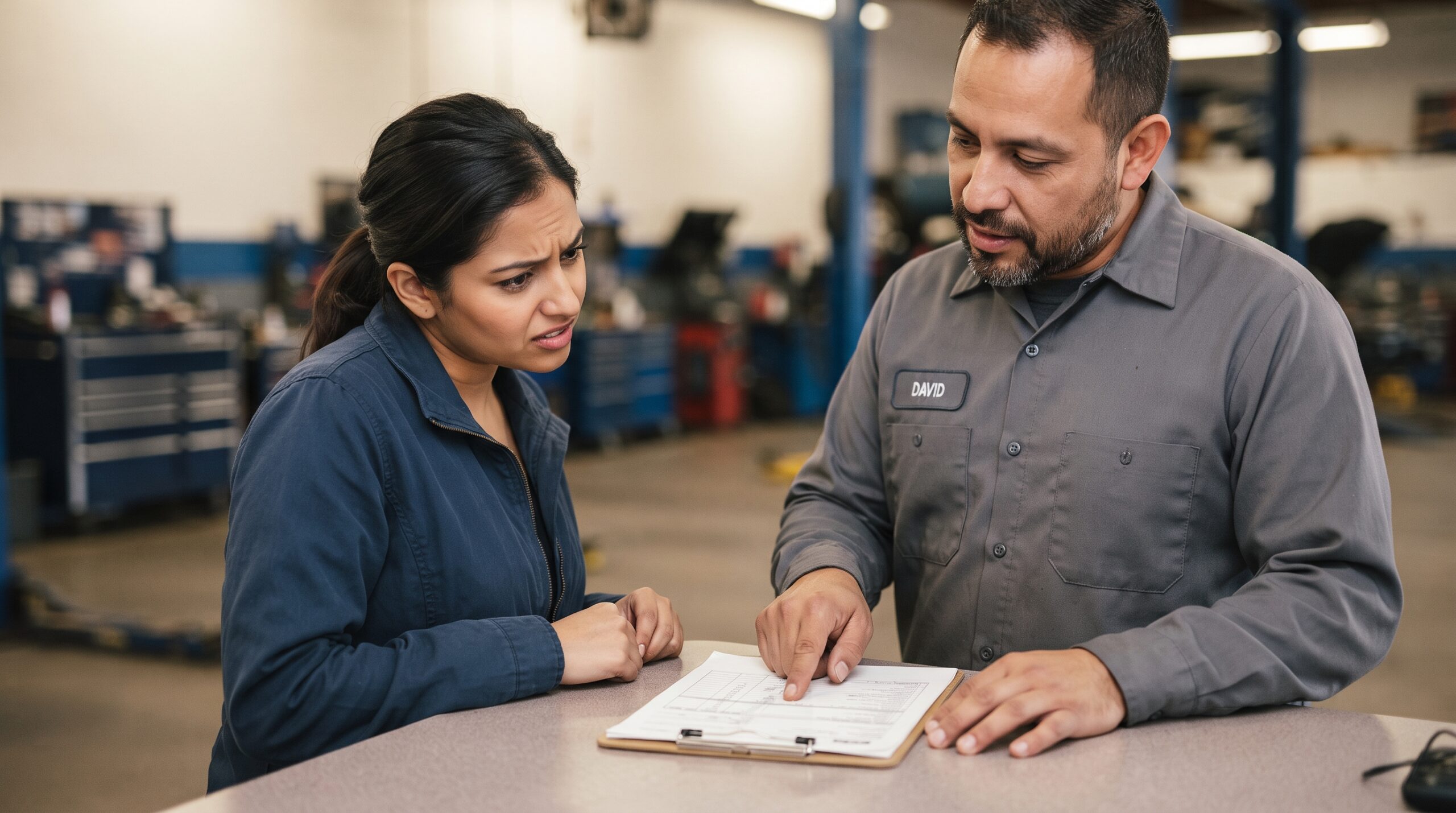
It cuts both ways. Take a harder version of the same job: a rusted bolt turns a 2.4-hour book job into 3.5 hours of real wrench time. Under flat rate, the shop generally still bills the 2.4 book hours unless it goes back to you first for authorization to bill more, the same written-estimate rule covered below. The technician, or the shop, absorbs the extra 1.1 hours.
None of this means book time is padded. The Bureau of Labor Statistics’ price index for motor-vehicle maintenance and repair rose 7.0% between June 2025 and June 2026, which tracks what shops charge overall, not the published hours themselves. The hourly rate you’re billed against the book is what’s climbing. The book’s hour count for a given job changes far more slowly.
| Factor | Flat-Rate Billing | Actual-Time Billing |
|---|---|---|
| How the price is set | A published labor guide’s estimated hours for that job | The technician’s own clock time on your car |
| If the job runs faster than book | You still pay the full book hours | You pay less, for less time worked |
| If the job runs slower than book | The shop generally can’t bill past the estimate without your OK | You pay more, for more time worked |
| Best for | Predictable pricing across different technicians | Jobs with unpredictable complexity, once you trust the shop’s clock |
Your rights when the estimate and the bill don’t match
California’s Bureau of Automotive Repair requires shops to give a written estimate before starting work. The final bill generally can’t exceed that estimate without your separate authorization, obtained after the shop determines more time or parts are needed. The FTC notes that similar rules exist in other states too. Before you approve any repair, ask directly whether the shop bills flat rate or actual time. Ask to see the book-time hours listed on the written estimate, not just the total. If the invoice ever lists more hours than the estimate quoted and nobody called you first, that’s the exact situation the written-estimate rule exists to prevent, and you have grounds to push back.
Book time explains where the labor hours on your bill come from. It does not cover what happens when a shop finds more work once the car is already apart. See what your state requires before a shop can charge more than the written estimate for that part of the math.
Frequently asked questions
What does “flat rate” mean on my repair invoice? It means the shop billed you a published labor guide’s estimated hours for your specific repair, not the technician’s actual clock time. The FTC confirms this is based on “an independent or manufacturer’s estimate,” built from industry-wide time studies rather than your car in particular.
Is flat-rate billing legal? Yes. It’s a standard, widely used pricing model across dealers and independent shops nationwide. What the law does require, in California and similar states, is a written estimate before work starts and your authorization before the final bill can exceed it.
How do I know if my shop bills flat rate or actual time? Ask before you approve the repair. Request that the written estimate list the labor hours separately from the parts cost, and ask the advisor directly whether those hours come from a labor guide or the technician’s clock. Most shops will tell you plainly.
What if a job takes way longer than the book time says? Under a written-estimate law like California’s, the shop generally has to contact you and get authorization before billing past the original estimate. If your final invoice shows more hours than you approved and nobody called, that’s worth disputing directly with the shop.
Can I negotiate the labor rate itself? Sometimes. The posted hourly rate varies by shop, so it’s reasonable to ask, especially for a large job. What’s rarely negotiable is the book-time hours themselves, since those come from the labor guide, not the shop’s own pricing decision.
Leave a Reply