5 min read · Last updated October 26, 2026
- Under 16 CFR 700.10, a warranty cannot be conditioned on outside service. The warrantor (the manufacturer) may deny liability only where it can demonstrate that the outside work caused the defect.
- A dated service receipt, even a $42 handwritten one from an independent shop, is the kind of document that answers a missing-records denial.
- Escalating past the service writer to the manufacturer, with a documented case number, gives your records a second reviewer.
- In California, four failed repairs of one problem, or two for a serious safety defect, within 18 months or 18,000 miles create a lemon-law presumption. Better Business Bureau (BBB) AUTO LINE offers free arbitration meanwhile.
A warranty claim should not be denied just because you used an independent shop or an aftermarket part. Under federal regulation 16 CFR 700.10, the warrantor, meaning the manufacturer, can deny liability only where it can demonstrate that the outside work caused the defect.
In this article
- What Actually Lets a Dealer Deny a Covered Repair
- The Documentation That Reverses a Denied Warranty Claim
- The Escalation Sequence When the Service Writer Says No
- The Worked Example: What the Paper Trail Was Worth
- When a Denial Pattern Becomes a Lemon-Law Case
- Frequently asked questions
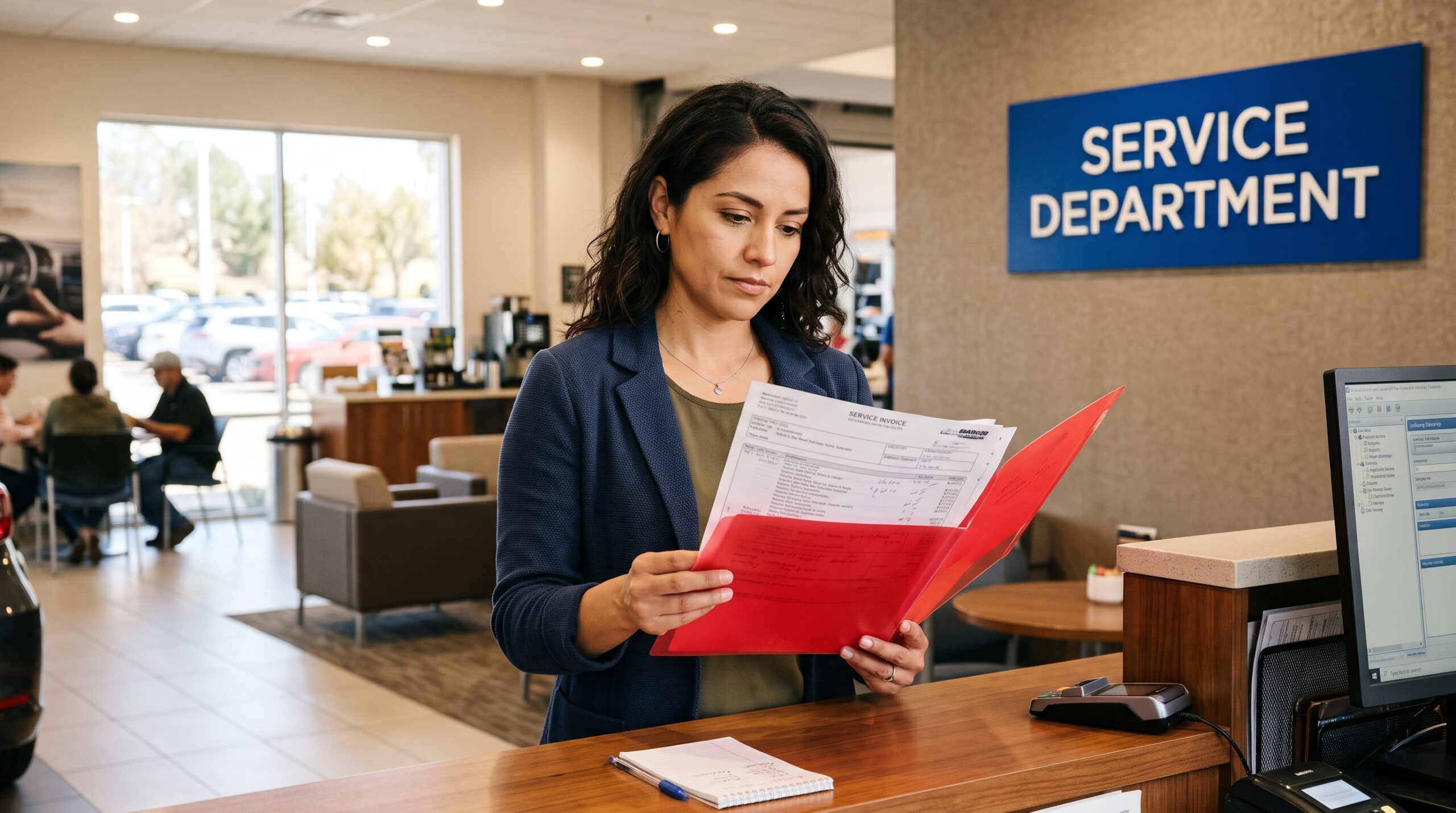
Take Dana, whose dealer denied a $4,350 transmission repair over a missing 60,000-mile transmission fluid service record.
What Actually Lets a Dealer Deny a Covered Repair
A federal regulation, 16 CFR 700.10, bars a warranty from being conditioned on using the manufacturer’s own service or parts.
The same rule lets the warrantor deny liability for one specific defect, but only where it can demonstrate that the outside work caused it.
“You didn’t buy it here” is not proof. Neither is “we don’t see records,” since the rule asks the warrantor to demonstrate causation, not you to disprove it.
The Documentation That Reverses a Denied Warranty Claim
Start with every receipt for the system the dealer flagged, even a handwritten one from a quick-lube chain. A dated invoice naming the actual service beats a perfect memory of when it happened.
Get the denial in writing, with the specific reason stated, not a verbal “it’s not covered.” A written reason is what a manufacturer rep or an arbitrator actually responds to.
If the dealer’s reasoning still doesn’t hold up, pay for an independent written diagnosis naming the real cause of failure. That cost can be small next to the repair itself, and it directly rebuts an unsupported denial.
The Escalation Sequence When the Service Writer Says No
One sensible order for a dispute, as a general suggestion rather than a rule, looks like this.
- Step 1: Ask the service manager to put the denial and its stated reason in writing.
- Step 2: Call the manufacturer’s customer relations line and open a documented case, attaching your records.
- Step 3: Ask whether your case can be reviewed by a manufacturer regional or district representative.
- Step 4: If the manufacturer still says no, file with Better Business Bureau (BBB) AUTO LINE for free arbitration.
The Worked Example: What the Paper Trail Was Worth
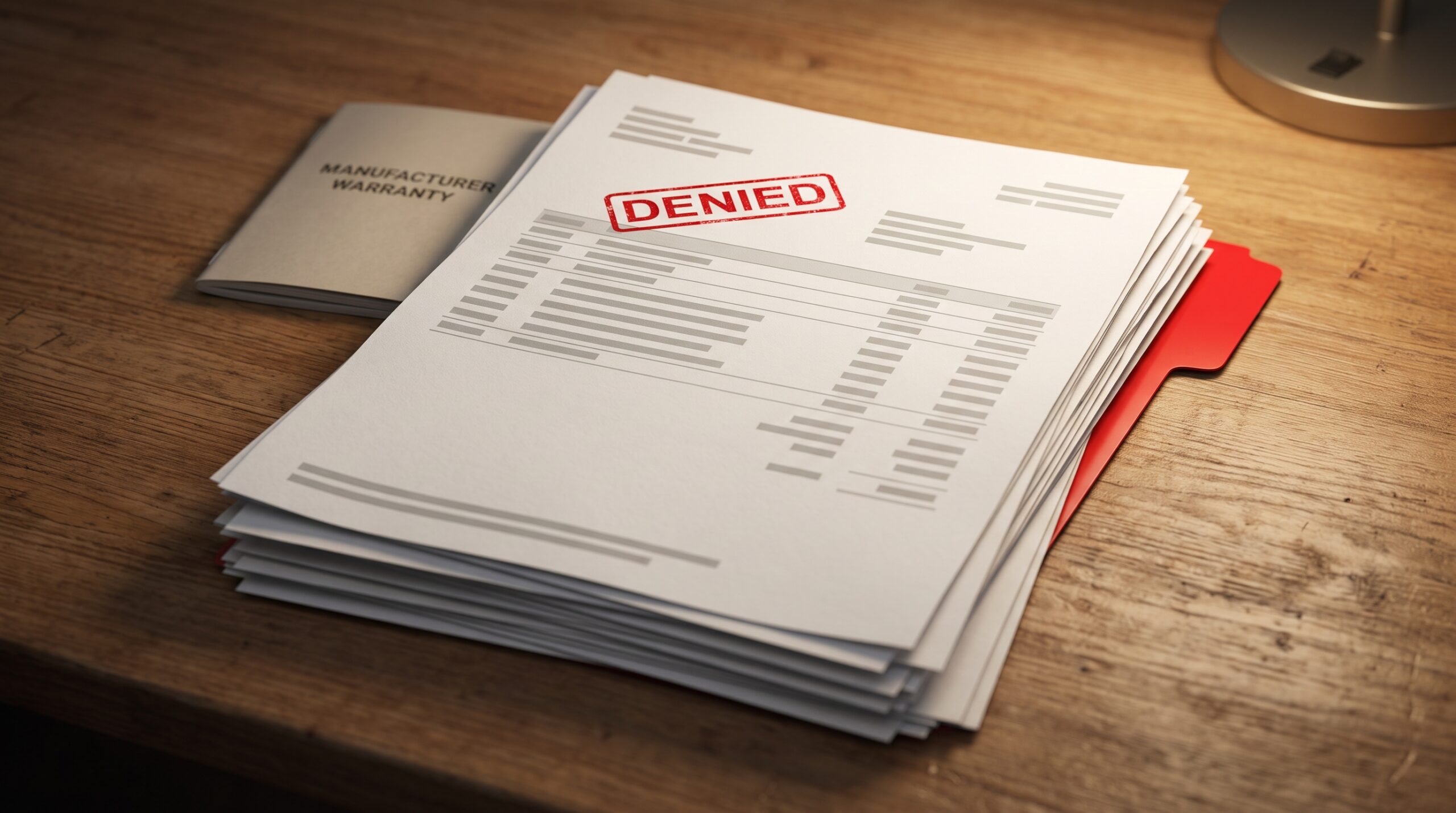
Dana’s transmission repair was quoted at $4,350. The dealer’s denial letter cited no proof of the required fluid service at 60,000 miles.
Dana found a $42 handwritten receipt from an independent shop proving that fluid service happened. A $150 second-opinion report then confirmed the real, unrelated cause of the transmission failure. Total spent to fight the denial: $192.
That $192 is about 4.4 percent of the original $4,350 bill. Once the manufacturer reviewed the documentation, the dealer repaired the transmission under warranty at no cost to Dana.
When a Denial Pattern Becomes a Lemon-Law Case
Sometimes the dealer approves the repair and it still doesn’t fix the problem. If your warranty had already expired before that pattern started, the goodwill-repair path works differently, since there’s no coverage left to dispute.
In California, the state’s lemon law, Civil Code Section 1793.22, creates a legal presumption after four repair attempts on the same problem. A safety defect that could cause death or serious injury needs only two attempts to trigger it. That window runs 18 months or 18,000 miles, whichever comes first, and it requires notifying the manufacturer directly at least once.
More than 30 cumulative calendar days out of service counts too, even without four separate repair attempts. Every state’s lemon law sets its own numbers, so check your own statute before assuming California’s thresholds apply. And if the dealer’s own repeat attempt is what fails, who pays for a repeat failure under warranty is its own separate question.
Frequently asked questions
What’s the most common illegitimate reason dealers give for denying a warranty claim? “Lack of maintenance records” tops the list, followed by claims that an aftermarket part or outside shop voided coverage. Under 16 CFR 700.10, the warrantor can deny liability only where it can demonstrate that outside work caused the defect. A missing record on your side is not that proof.
Does using an independent shop for oil changes void my new-car warranty? No. Federal regulation bars conditioning your warranty on using a particular shop for routine maintenance. The exception is where the warrantor can demonstrate that independent work caused the specific defect you’re claiming.
How long does manufacturer escalation take before I should go to arbitration? There’s no fixed deadline, so ask the manufacturer for a response date when you open the case. If the answer is still no, Better Business Bureau AUTO LINE covers participating manufacturers, and its decision binds the manufacturer once you accept it.
Is Better Business Bureau AUTO LINE arbitration free? Yes. Better Business Bureau AUTO LINE charges vehicle owners nothing; manufacturers fund the program instead. You can also walk away from an informal settlement offer and go straight to arbitration if you’re eligible, and the decision only binds you if you choose to accept it.
What if my state doesn’t have a lemon law like California’s? Every state has some version of a lemon law, but the repair-attempt and days-out-of-service thresholds vary widely. Check your own state attorney general’s consumer protection page for the exact numbers before assuming California’s four-attempt or 30-day rule applies to your car.
Leave a Reply